Historic SpaceX IPO Is Locked Out of the S&P 500 — Here’s What That Means for You

The largest initial public offering in stock market history has arrived — but if your retirement savings sit in an S&P 500 index fund, you won’t be getting a slice of SpaceX anytime soon.
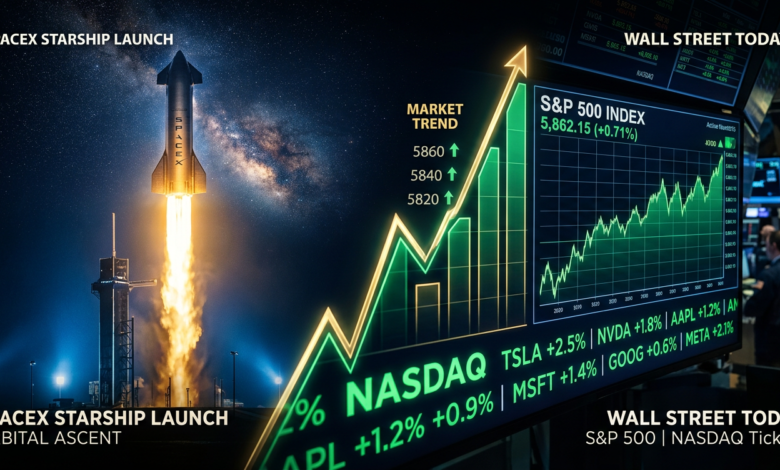
SpaceX began trading on the Nasdaq on Friday, briefly soaring to a market capitalisation above $2 trillion. Despite that staggering valuation, the committee that governs S&P 500 index rules has decided to enforce its standard 12-month waiting period before considering the stock for inclusion — leaving millions of passive investors on the sidelines for at least a year, and potentially much longer.
Why S&P 500 Investors Won’t Own SpaceX — Yet
The core issue is twofold. First, the S&P 500 index committee upheld its rule requiring new public companies to trade for a minimum of 12 months before becoming eligible for inclusion. Second — and potentially more consequential — the committee also maintained its profitability requirement. SpaceX reported a net loss of $4.28 billion in its most recent quarter, making it ineligible on financial grounds even if the waiting period were waived.
Peter Haynes, head of index and market structure research at TD Securities, was openly critical of the decision. “Personally, I didn’t agree with the decision,” he said on CNBC’s ETF Edge. Haynes drew a parallel to Saudi Aramco’s 2019 IPO — the previous record-holder — when both FTSE and MSCI fast-tracked the stock into global benchmarks within five to ten days. “U.S. benchmarks were geared to follow the lead of global benchmarks,” he said. “They have a ‘Made in the USA’ stock that is sizable and belongs in benchmarks.”
Nasdaq and Russell Take a Different Path
Not every major index provider agreed with the S&P’s conservative stance. The Nasdaq and Russell index committees both announced they would update their rules to allow SpaceX to be added to their benchmarks — including the Nasdaq 100 and the Russell 1000 — on an accelerated timeline.
That divergence carries real consequences for investors. Todd Sohn, chief ETF strategist at Strategas Securities, put it plainly: “If you want SpaceX, you’re not buying the S&P 500. You’re going to buy the Nasdaq 100 or the Russell 1000.”
Sohn also warned that the split decisions could ignite what he called an “index war” — meaningful performance gaps opening up between the S&P 500 and competing benchmarks as mega-cap tech and space names land in some indexes but not others.
OpenAI and Anthropic Could Face the Same Wall
The implications stretch well beyond SpaceX. OpenAI and Anthropic — both expected to pursue massive IPOs in the near future — are burning through capital at a significant rate while building out their AI infrastructure. If they arrive at market unprofitable, they could face the same dual barrier: the 12-month waiting period and the S&P’s profitability test.
“What this is doing is setting a precedent that the S&P will not add OpenAI and Anthropic when those IPOs happen,” Sohn said.
Haynes added that even after the 12-month window closes, S&P 500 investors may wait “much longer” for SpaceX exposure if the profitability hurdle remains uncleared.
How Investors Can Get SpaceX Exposure Now
For those who don’t want to wait, there are already several routes to SpaceX before it lands in the S&P 500:
- Thematic space ETFs — A handful of funds held pre-IPO stakes in SpaceX through direct investments. The Tema ETFs Space Innovators ETF (NASA), which launched on May 30, has quickly attracted $2.6 billion in assets and offers direct SpaceX exposure.
- Leveraged ETFs — ProShares is set to launch the Ultra SpaceX ETF (SPCF) next Monday, targeting 2x the daily performance of the stock. GraniteShares will follow with two similar products: a 2x long fund (SPAL) and a 2x short fund (SNK).
- Nasdaq or Russell ETFs — Since both indexes plan to include SpaceX on a fast track, ETFs tracking these benchmarks will provide indirect exposure sooner than any S&P 500 fund.
A word of caution on leveraged products: Sohn noted that these instruments are designed for active traders, not long-term investors. Losses compound quickly, expense ratios are elevated, and the boom-and-bust cycles can be severe.
The Bigger Picture for Index Investors
For the tens of millions of Americans whose retirement savings are anchored in S&P 500 vehicles — the Vanguard VOO and BlackRock IVV together manage nearly $2 trillion in assets, with VOO recently crossing the $1 trillion mark — the message is sobering: the index they have long relied on to capture the biggest names in the U.S. market is sitting this one out.
Whether that is prudent gatekeeping or a missed opportunity depends on your perspective. What is certain is that the gap between what the S&P 500 holds and what the broader market looks like is about to get wider — and that divergence could define index fund performance for years to come.
As Sohn put it, expect the ETF industry to respond creatively: “There is nothing the ETF industry can’t do in terms of creativity.” Expect to see S&P+SpaceX, large-cap+Anthropic, and other bespoke index products arriving from independent issuers in the months ahead.
Disclaimer
This article is for informational purposes only and does not constitute financial or investment advice. Always conduct your own research and consult a qualified financial advisor before making investment decisions.