
A year ago, Mark Zuckerberg made the boldest move of his career outside social media — spending more than $14 billion to bring Scale AI founder Alexandr Wang and a team of his top engineers into Meta. The goal was to fundamentally reshape the company’s AI capabilities. Twelve months on, Meta has a new proprietary model in hand. Now comes the harder part: making it pay.
Muse Spark Marks Meta’s Shift Away From Open Source
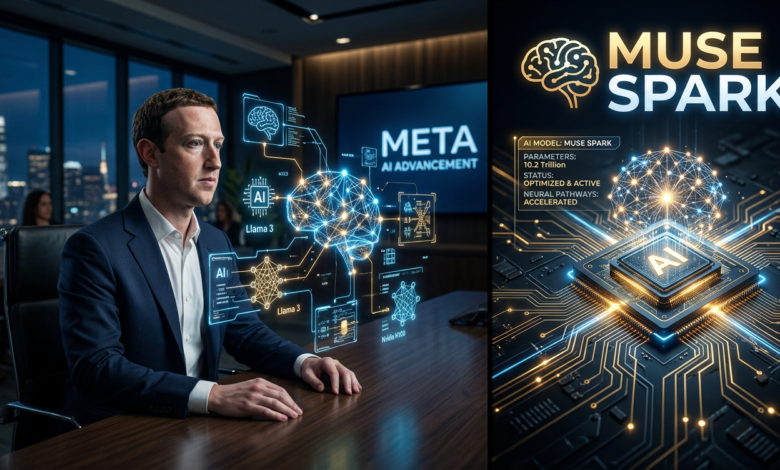
Wang’s most significant contribution since joining Meta has been the April launch of Muse Spark, the company’s first proprietary foundation model. It represents a deliberate pivot away from the open-source strategy that defined Meta’s earlier AI efforts through its Llama family of models. Wang leads the initiative through Meta Superintelligence Labs, a division created specifically to give the company credibility in frontier AI development. Rather than courting third-party developers as Llama did, Muse Spark was built to integrate directly into Meta’s own ecosystem — Facebook, Instagram, Ray-Ban Meta smart glasses, and the standalone Meta AI app.
Thomas Randall, an analyst at the Info-Tech Research Group, said the strategic rationale is clear. Without a reliable proprietary model it owns outright, Meta would be “lost,” he argued. While he acknowledged that Meta has not taken the “most optimized route,” he said he can now see a coherent vision emerging from Wang’s work. “This is a strategic rebuild,” Randall said.
Wall Street Wants Proof, Not Promises
Despite reporting 33% revenue growth in the first quarter of 2026 — its fastest expansion since 2021 — Meta’s stock has fallen 18% over the past year, making it the worst performer among megacap technology companies alongside Microsoft. Investors are signalling that advertising growth alone is no longer enough.
Ralph Schackart, an analyst at William Blair who carries a buy rating on the stock, put the challenge plainly. “Meta needs to provide more proof points of both adoption and commercialisation,” he said. “Investors are looking for Meta to monetise a new AI-first product, beyond the substantial positive impact AI is having on enhancing the advertising models.”
The pressure is compounded by Meta’s historical inability to generate meaningful revenue outside of online advertising. The company still derives 98% of its income from ads. Since Muse Spark’s launch, Meta has begun testing AI subscription plans starting at $7.99 per month — but whether consumers will pay for what they have long received for free remains an open question.
The Developer Trust Problem
One of Wang’s biggest obstacles is repairing Meta’s relationship with the developer community — a relationship that was badly damaged by the underwhelming release of Llama 4 in April 2025. That launch failed to resonate with developers and directly triggered Zuckerberg’s decision to restructure the company’s AI approach entirely.
Rob May, CEO of token engineering startup Neurometric, was blunt in his assessment. “The AI community largely ignores Meta at this point,” he said, describing Muse Spark as a “yawn” given how inaccessible the technology remains to outside builders. May said he used to communicate regularly with Meta over Llama-related issues but can no longer get responses.
Krish Subramanian, CEO of consulting firm KOI AI, warned that neglecting developers could have lasting consequences. He drew a comparison to Microsoft’s early struggles with open-source developers during the rise of Azure, noting it took years for the company to rebuild trust. “The lack of developer trust will come back to hit them if they don’t focus on third-party developers,” he said. “To just focus on a walled-garden kind of ecosystem and ad revenue as the main source of income, they probably will never become the big player.”
Meta has said it still intends to give outside developers API access to Muse Spark’s underlying technology. A company spokesperson said testing with early partners is already underway, with a wider release planned. Andrew Moore, CEO of enterprise AI startup Lovelace and a former Google Cloud AI chief, said Meta’s focus on computational efficiency could still carve out a meaningful niche. “If they do proprietary, computationally efficient models, that will be so different from what’s happening in this death match between the big guys,” he said.
Internal Pressure and Leadership Tensions
Behind the scenes, the mood inside Meta’s AI organisation is complicated. The company has made sweeping job cuts throughout 2026, including the dismissal of approximately 8,000 workers in May. Among those affected were employees in trust and safety roles — a development that has raised concerns internally about risks that can emerge in AI development, according to people familiar with the matter.
There is also reported tension between Wang and former GitHub CEO Nat Friedman, another high-profile hire from last summer, as both face mounting pressure to show tangible revenue results from Muse Spark. Meta’s long-serving tech chief Andrew Bosworth, a two-decade company veteran and close Zuckerberg ally, is seen by some as a fallback option should the newer arrivals be perceived as underdelivering.
Wang has publicly downplayed reports of internal conflict and described Muse Spark as an “appetiser” for more powerful models yet to come. But the AI industry runs on momentum, and rivals like OpenAI, Anthropic and Google release updates at a pace Meta has not matched.
Zuckerberg’s Credibility on the Line
Ultimately, analysts say the success or failure of Meta’s AI ambitions rests with Zuckerberg himself. Howard Yu, a business professor at the International Institute for Management Development in Switzerland, said the CEO’s role is to define and communicate a clear vision — especially when billions of dollars are at stake.
That task is made harder by the shadow of the metaverse. Meta’s Reality Labs division has accumulated more than $80 billion in losses since late 2020, a track record that gives investors reason to scrutinise the AI pivot carefully. “He’s running out of space for his credibility to last,” Yu said. “The virtual reality foray may have burned up a lot of his goodwill in front of investors.”
Schackart said the near-term benchmark is straightforward: a growing catalogue of AI-first products built on Muse Spark, even if revenue takes time to follow. “That’s what investors are looking for,” he said. For now, the model exists. The market is waiting to see what Zuckerberg does with it.