

Quick ZK Technology Comparison Table
| Feature / Metric | zk-SNARKs | zk-STARKs | PLONK | Bulletproofs |
| Full Name | Zero-Knowledge Succinct Non-Interactive Argument of Knowledge | Zero-Knowledge Scalable Transparent Argument of Knowledge | Permutations over Lagrange-bases for Oecumenical Non-interactive arguments of Knowledge | Bulletproofs (Short Non-Interactive Zero-Knowledge Proofs) |
| Proof Size | Extremely Succinct (~ hundreds of bytes) | Larger (~ tens to hundreds of kilobytes) | Small (~ hundreds of bytes to single-digit KB) | Small (~ single-digit kilobytes) |
| Verification Speed | Fast (~ constant time) | Extremely Fast (Scales logarithmically) | Fast (Constant time pairing checks) | Slower (Scales linearly with circuit size) |
| Trusted Setup Required? | Yes (Traditionally per-circuit; universal in newer variants) | No (Transparent) | Universal trusted setup (One-time ceremony) | No (Transparent) |
| Post-Quantum Secure? | No (Relies on elliptic curve discrete log assumptions) | Yes (Relies on collision-resistant hash functions) | No (Relies on elliptic curves) | No (Relies on discrete log assumption) |
| Primary Use Cases | ZK rollups, private transactions (Zcash), zkEVMs | High-throughput rollups (Starknet), large computational circuits | General-purpose smart contract proving, modern zkVMs | Range proofs, Confidential Transactions (Monero) |
Blockchain technology solved the challenge of decentralized consensus, but early networks introduced a core structural bottleneck: every single node on the network had to independently re-execute every transaction to verify its validity. This design capped transaction throughput and forced all transaction data to remain permanently public.
Zero-knowledge proofs (ZKPs) resolve this trade-off. By combining modern cryptography with advanced hardware acceleration, zero-knowledge proofs allow a network participant to prove that a transaction or complex computation is valid without requiring every node to re-execute it—and without revealing unnecessary underlying data. This article breaks down zero-knowledge technology, how ZK rollups and zkEVMs operate in production, and how cryptographic verification is reshaping the next generation of digital infrastructure.
What Is a Zero-Knowledge Proof?
A zero-knowledge proof is a cryptographic primitive that enables one party (the prover) to mathematically convince another party (the verifier) that a specific statement is true, without revealing any information beyond the validity of the statement itself.
A Simple Analogy: The Cave of Ali Baba
Imagine a circular cave with a single entrance that splits into two paths, Path A and Path B. Deep inside the cave, a locked magical door blocks the passage between Path A and Path B. The door can only be unlocked by someone who knows a secret passphrase.
Alice claims she knows the passphrase. Bob wants proof, but Alice refuses to share the passphrase with him.
                  ┌───────────────────────────────┐
                  │        Cave Entrance          │
                  └───────────────┬───────────────┘
                                  │
                       ┌──────────┴──────────┐
                       ▼                     ▼
                 ┌───────────┐         ┌───────────┐
                 │  Path A   │         │  Path B   │
                 └─────┬─────┘         └─────┬─────┘
                       │                     │
                       └──────────┐ ┌────────┘
                                  ▼ ▼
                           ┌──────────────┐
                           │ Magical Door │
                           │ (Secret Key) │
                           └──────────────┘
-
Bob stands outside the entrance so he cannot see which path Alice enters.
-
Alice walks down either Path A or Path B.
-
Bob approaches the split and shouts a random instruction: “Alice, come out through Path A!”
-
If Alice entered Path B, she must unlock the magical door using the secret passphrase to exit via Path A.
-
If Bob repeats this test 30 times in a row, and Alice successfully emerges from the requested path every time, the mathematical probability of her guessing correctly without knowing the passphrase drops to less than 1 in 1 billion ($1 / 2^{30}$).
Bob becomes fully convinced that Alice knows the secret passphrase, even though Alice never revealed the passphrase to Bob.
Analogy Disclaimer: While the cave analogy explains interactive verification conceptually, real-world blockchain ZK proofs rely on non-interactive polynomial mathematics and hash commitments rather than physical back-and-forth guessing games.
The Three Core Properties of ZK Proofs
To be cryptographically sound, every zero-knowledge proof system must satisfy three fundamental properties:
-
Completeness: If the statement is true and both the prover and verifier follow the protocol correctly, the verifier will always accept the proof.
-
Soundness: If the statement is false, a cheating prover cannot convince the verifier that it is true, except with a mathematically negligible probability.
-
Zero-Knowledge: If the statement is true, the verifier learns absolutely nothing about the underlying secret data beyond the fact that the statement is valid.
The Three Core Parties
-
Prover: The entity performing the computation and generating the mathematical proof.
-
Verifier: The entity inspecting the proof to accept or reject its validity.
-
Statement: The specific mathematical claim being verified (e.g., “This batch of 1,000 transactions was executed correctly according to network rules”).
How a Zero-Knowledge Proof Works Step by Step
In modern software applications, non-interactive zero-knowledge proofs execute through a multi-stage computational pipeline:
┌─────────────────────────────────────────────────────────────────────────┐
│ 1. Secret / Private Input + Computation                                 │
├─────────────────────────────────────────────────────────────────────────┤
│ 2. Arithmetization (Converting Code into Mathematical Polynomials)      │
├─────────────────────────────────────────────────────────────────────────┤
│ 3. Prover Engine (Generating the Cryptographic Proof Object)           │
├─────────────────────────────────────────────────────────────────────────┤
│ 4. Compact Proof Sent Onchain                                            │
├─────────────────────────────────────────────────────────────────────────┤
│ 5. Verifier Smart Contract (Checks Proof and Updates State Root)       │
└─────────────────────────────────────────────────────────────────────────┘
-
Arithmetization: The program logic (such as an EVM smart contract execution) is translated into a set of mathematical constraints known as an arithmetic circuit.
-
Execution & Witness Generation: The prover runs the computation using both public inputs (e.g., previous state root) and private inputs (e.g., signatures, private keys, or intermediate execution traces). The full execution trace is called the witness.
-
Proof Generation: The prover engine evaluates the witness against the arithmetic circuit, constructing a succinct mathematical proof object (e.g., a SNARK or STARK).
-
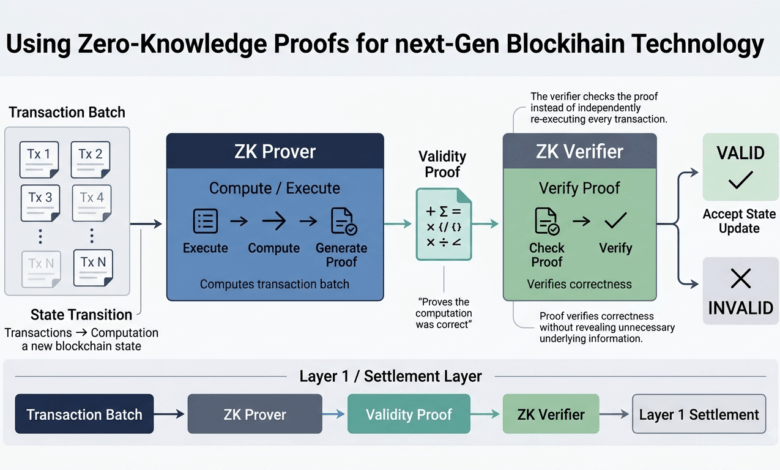
Verification: The compact proof is transmitted to the verifier (often a smart contract on Ethereum). The verifier runs a fast mathematical check against the public inputs. If the math checks out, the verifier accepts the state update without repeating the original execution.
The Main Types of Zero-Knowledge Proofs
Different proof constructions make distinct cryptographic trade-offs between proof size, generation speed, verification cost, and security assumptions:
1. zk-SNARKs (Succinct Non-Interactive Arguments of Knowledge)
-
Concept: The dominant early ZK proof family. SNARKs are famous for generating extremely small proof objects (often just a few hundred bytes) that can be verified in a constant few milliseconds.
-
Characteristics: High verification efficiency and tiny proof size.
-
Trade-Offs: Many traditional SNARKs require a trusted setup ceremony to generate structured reference string parameters. If the secret randomness used in the setup is compromised, an attacker could forge fake proofs. Additionally, standard SNARKs rely on elliptic curves that are not post-quantum secure.
2. zk-STARKs (Scalable Transparent Arguments of Knowledge)
-
Concept: Pioneered by StarkWare, STARKs replace elliptic curve assumptions with hash functions.
-
Characteristics: Fully transparent—they require no trusted setup ceremony. They are also post-quantum secure, resisting potential threats from future quantum computers.
-
Trade-Offs: Proof sizes are substantially larger than SNARKs (ranging from tens to hundreds of kilobytes), which can result in higher onchain storage and data availability costs when posting proofs to Layer-1.
3. PLONK
-
Concept: A universal proving system that improved upon early SNARK designs.
-
Characteristics: Uses a universal trusted setup. The setup ceremony only needs to be performed once for the entire system; developers do not need to run new ceremonies when updating smart contract circuits.
-
Use Cases: Widely integrated across modern zkEVM implementations and proving networks.
4. Bulletproofs
-
Concept: Short, non-interactive zero-knowledge proofs designed specifically for range checks without requiring a trusted setup.
-
Characteristics: Highly compact for validating hidden numeric values within specific bounds.
-
Use Cases: Frequently used in privacy-preserving financial applications (such as Monero’s Confidential Transactions) to prove that a hidden transfer amount is greater than zero without revealing the actual value.
Why Zero-Knowledge Proofs Matter for Blockchain
Blockchain infrastructure faces three fundamental challenges that ZK technology addresses:
               ┌─────────────────────────────────────────┐
               │    Core Benefits of ZK Infrastructure    │
               └────────────────────┬────────────────────┘
                                    │
         ┌──────────────────────────┼──────────────────────────┐
         ▼                          ▼                          ▼
┌──────────────────┐       ┌──────────────────┐       ┌──────────────────┐
│   Scalability    │       │     Privacy      │       │ Trustless Verif. │
├──────────────────┤       ├──────────────────┤       ├──────────────────┤
│ Thousands of     │       │ Prove claims     │       │ Eliminate global │
│ txs compressed   │       │ without exposing │       │ re-execution of  │
│ into one proof   │       │ user data        │       │ heavy compute    │
└──────────────────┘       └──────────────────┘       └──────────────────┘
1. Scalability
Instead of forcing thousands of nodes on Ethereum Layer-1 to execute every smart contract step, a Layer-2 network processes thousands of transactions offchain, generates a single succinct proof, and posts that proof to Ethereum. Ethereum nodes verify the proof in milliseconds, scaling system throughput by orders of magnitude.
2. Privacy
Traditional public blockchains log every address, wallet balance, and contract interaction on an open ledger. Zero-knowledge cryptography allows users and institutions to prove compliance, solvency, or ownership without publishing underlying sensitive transactional details to the world.
3. Verification over Re-execution
ZK technology separates computation from verification. Provers can spend substantial hardware resources completing complex, heavy computations offchain. The resulting proof allows light clients, mobile devices, or base-layer smart contracts to verify the outcome instantly without re-running the heavy work.
What Is a ZK Rollup?
A ZK rollup is an Ethereum Layer-2 scaling architecture that batches thousands of offchain transactions, executes them in a high-performance environment, and submits a cryptographic validity proof to an Ethereum Layer-1 smart contract to finalize the state change.
┌─────────────────────────────────────────────────────────────────────────┐
│ L2 Execution: Users submit thousands of transactions to the Sequencer    │
├─────────────────────────────────────────────────────────────────────────┤
│ Batching: Sequencer bundles transactions & updates local state root     │
├─────────────────────────────────────────────────────────────────────────┤
│ Proving: Dedicated Prover engine generates cryptographic Validity Proof │
├─────────────────────────────────────────────────────────────────────────┤
│ Settlement: Validity Proof + Data Blobs submitted to Ethereum L1        │
├─────────────────────────────────────────────────────────────────────────┤
│ Verification: L1 Smart Contract verifies proof & updates canonical state│
└─────────────────────────────────────────────────────────────────────────┘
Core Components of a ZK Rollup
-
Sequencer: Collects, orders, and executes user transactions offchain, providing instant soft confirmations.
-
Prover Engine: Specialized hardware nodes that convert the executed batch into a cryptographic validity proof.
-
L1 Bridge & Verifier Contract: A set of smart contracts deployed on Ethereum that verify the submitted proof and hold locked user assets.
-
State Commitment & Data Availability: The rollup posts state roots and compressed transaction data (often using EIP-4844 data blobs) to Ethereum so anyone can reconstruct the L2 state if needed.
Technical Distinction: A ZK Rollup primarily uses cryptographic proofs for scalability and computational correctness (via validity proofs). A ZK rollup is not automatically a private network; unless privacy mechanisms are explicitly built into the L2 execution layer, transactions on public ZK rollups remain visible on block explorers.
ZK Rollup vs Optimistic Rollup
Layer-2 rollups fall into two primary architectural categories: ZK Rollups (which use validity proofs) and Optimistic Rollups (which use fraud-proof challenge windows).
| Feature / Dimension | ZK Rollup | Optimistic Rollup |
| Main Security Mechanism | Cryptographic Validity Proof (Math-based) | Fraud Proofs & Economic Penalties (Incentive-based) |
| Proof Submission Model | Proves every state transition is correct before L1 finalization | Assumes transactions are valid optimistically unless challenged |
| L1 Withdrawal Finality | Fast (Minutes to hours, as soon as the validity proof lands on L1) | Slow (~7-day challenge window required for native bridge withdrawals) |
| Computational Burden | Prover-heavy (High offchain mathematical computation required) | Execution-light (Simple offchain execution, low proving overhead) |
| Data Efficiency | High (Only needs to post state changes and compressed proofs) | Lower (Must post full transaction inputs for potential fraud challenges) |
| Main Advantage | Instant cryptographic finality; smaller onchain footprint | Simpler initial architecture; 100% native EVM equivalence early on |
| Main Limitation | High computational cost and hardware overhead for provers | Long withdrawal delays without liquidity providers |
What Is a zkEVM?
A zkEVM (Zero-Knowledge Ethereum Virtual Machine) is a virtual machine that executes smart contract code in a way that is compatible with Ethereum while generating zero-knowledge validity proofs of the execution trace.
Early ZK proof systems could only handle simple, custom transfers. Building a general-purpose zkEVM was long considered a major engineering hurdle because Ethereum’s native virtual machine was not originally designed with polynomial-friendly cryptographic operations in mind.
zkEVM Compatibility Spectrum
Vitalik Buterin categorized zkEVM architectures into distinct types based on the trade-off between strict EVM equivalence and prover performance:
                          ┌──────────────────────────┐
                          │    zkEVM Types Spectrum  │
                          └────────────┬─────────────┘
                                       │
         ┌─────────────────────────────┼─────────────────────────────┐
         ▼                             ▼                             ▼
┌──────────────────┐          ┌──────────────────┐          ┌──────────────────┐
│ Type 1: Fully    │          │ Type 2/2.5: Fully│          │ Type 4: High-    │
│ Ethereum-Equal   │          │ EVM-Equivalent   │          │ Level Language   │
├──────────────────┤          ├──────────────────┤          ├──────────────────┤
│ Identical to L1; │          │ Exact VM spec;   │          │ Compiles Rust/   │
│ slow proving.    │          │ optimized proofs.│          │ Solidity to ZK.  │
└──────────────────┘          └──────────────────┘          └──────────────────┘
-
Type 1 (Fully Ethereum-Equivalent): Strives for total equivalence with Ethereum core consensus. It makes zero changes to consensus rules, gas costs, or cryptographic logic. Proving times are long because no operations are optimized for ZK circuits.
-
Type 2 / Type 2.5 (Fully EVM-Equivalent): Looks identical to the EVM from the application layer down, but modifies internal data structures (like block structures and gas tables) to drastically accelerate proof generation.
-
Type 3 (Almost EVM-Equivalent): Modifies select EVM features that are exceptionally difficult to prove in ZK, improving prover speed while retaining compatibility for the vast majority of smart contracts.
-
Type 4 (High-Level Language Compatible): Takes smart contract code written in Solidity or Vyper and compiles it into a custom, ZK-optimized intermediate bytecode (IR). Proving is exceptionally fast, though some low-level EVM assembly patterns require modification.
Major Projects Using Zero-Knowledge Technology
The ZK ecosystem spans multiple production rollups, infrastructure providers, and specialized application layers:
| Project | ZK Technology Used | Primary Purpose | Architectural Focus |
| zkSync Era | Custom SNARK/PLONK-based proving | Layer-2 Scaling & Institutional Settlement | Native Account Abstraction, Type 4 VM architecture, hyperchain ecosystem |
| Starknet | STARK proofs (Cairo VM) | General-purpose L2 Scaling & Compute | High-throughput transparent STARKs, custom Cairo execution environment |
| Scroll | zk-SNARK / zkEVM | General-purpose L2 Scaling | Bytecode-level EVM equivalence (Type 2 focus), developer-friendly tooling |
| Linea | PLONK / SNARK-based recursion | General-purpose L2 Scaling | Consensys-backed EVM rollup, seamless integration with MetaMask ecosystem |
| Polygon zkEVM | STARK-to-SNARK recursion | L2 Scaling & Aggregated Liquidity | Converts heavy STARK execution into succinct SNARKs for cheap L1 verification |
| Aztec | Client-side PLONK (Noir language) | Private Smart Contracts | Native dual execution (private client-side state + public state) |
What Are ZK Provers and Verifiers?
The operational economics of zero-knowledge infrastructure depend on the relationship between provers and verifiers:
               ┌──────────────────────────────────────────┐
               │       Prover vs. Verifier Dynamics       │
               └────────────────────┬─────────────────────┘
                                    │
         ┌──────────────────────────┴──────────────────────────┐
         ▼                                                     ▼
┌───────────────────────────────┐             ┌───────────────────────────────┐
│         The Prover            │             │         The Verifier          │
├───────────────────────────────┤             ├───────────────────────────────┤
│ • High hardware burden        │             │ • Lightweight execution       │
│ • Parallelized GPUs/FPGAs/ASICs│             │ • Fast verification (ms)      │
│ • Evaluates complex circuits  │             │ • Runs as L1 Smart Contract   │
│ • Expensive compute footprint │             │ • Extremely cheap to operate  │
└───────────────────────────────┘             └───────────────────────────────┘
-
The Prover: Takes execution traces, structures them into arithmetic circuits, and runs complex mathematical algorithms to produce a proof. Proving requires substantial memory, parallelized GPU computing clusters, or dedicated FPGA/ASIC hardware.
-
The Verifier: Inspects the generated proof object against public inputs. Verification requires minimal computational power and executes in milliseconds inside a standard smart contract or light client.
The Rise of Proving Infrastructure and Hardware Acceleration
Because proof generation is computationally heavy, modern ZK ecosystems rely heavily on hardware acceleration:
-
GPU & FPGA Clusters: Proving teams use enterprise GPU farms and customized Field Programmable Gate Arrays (FPGAs) to parallelize polynomial math operations.
-
Decentralized Proving Networks: Protocol infrastructure projects aggregate global compute supply, allowing independent prover operators to compete to produce low-cost proofs for L2 rollups.
-
zkVMs (Zero-Knowledge Virtual Machines): General-purpose proving engines (such as RISC Zero or SP1) allow developers to write standard Rust or C++ code and automatically generate ZK validity proofs for any general computation.
How ZK Proofs Improve Blockchain Scalability
Zero-knowledge technology scales blockchains through three distinct mechanisms:
-
Computation Offloading: Instead of 10,000 Ethereum consensus nodes executing every transaction step-by-step, execution is offloaded to a single L2 environment. Ethereum nodes execute only a single verifier calculation.
-
Proof Recursion: Provers can generate proofs of other proofs. A prover can aggregate 100 individual transaction proofs into 1 meta-proof, and then bundle 100 meta-proofs into a single master proof. This recursive compression allows a single root proof verified on L1 to validate tens of thousands of underlying transactions.
-
Data Compression: ZK rollups do not need to post full transaction signatures or individual execution inputs to Layer-1. Because the cryptographic validity proof mathematically guarantees signature authenticity and state transition correctness, the rollup only posts minimal state diffs (changes in balances), drastically cutting data footprint.
Privacy Applications
While ZK rollups primarily leverage validity proofs for throughput scaling, zero-knowledge proofs are fundamentally designed to preserve data privacy.
┌─────────────────────────────────────────────────────────────────────────┐
│ Pure Validity Proof (Scaling): "This 10,000-transaction batch is valid." │
│ Data remains public on Layer-2 block explorers.                         │
├─────────────────────────────────────────────────────────────────────────┤
│ Privacy-Preserving ZK (Confidentiality): "I own a balance > $10,000."   │
│ Proved onchain without exposing wallet address, history, or balance.    │
└─────────────────────────────────────────────────────────────────────────┘
Selective Disclosure vs. Absolute Anonymity
Zero-knowledge privacy differs from simple mixer anonymity:
-
Fully Anonymous Systems: Obfuscate transaction origins entirely, which can introduce regulatory compliance challenges.
-
Selective Disclosure Systems: Allow users to keep private financial data off public ledgers while maintaining the technical ability to generate cryptographic proof-of-compliance for auditors, tax authorities, or designated third parties when required.
Zero-Knowledge Proofs and Digital Identity
Traditional online identity verification forces users to hand over copies of passports, driver’s licenses, and credit reports to third-party databases, creating honey pots for data breaches.
ZK proofs enable self-sovereign digital identity through selective disclosure:
-
Age Verification: A user can generate a ZK proof attesting, “I am over 21 years old,” using a government-issued cryptographic credential, without revealing their birth date, legal name, or residential address.
-
Credit & Accreditation Checks: An investor can prove, “My net worth exceeds the regulatory threshold,” without revealing their specific bank balances or bank account numbers.
-
Sybil Resistance: Platforms can verify that an account belongs to a unique human (e.g., via zero-knowledge proof of passport) without linking their real-world identity to their public wallet address.
Applications Beyond Blockchain
Zero-knowledge cryptography extends into broader enterprise computer science:
-
Financial Compliance & Auditing: Financial institutions can prove overall solvency and balance sheet asset backing without exposing individual customer balances or proprietary trading positions to competitors.
-
Healthcare Data Management: Medical researchers can analyze verified patient outcomes across institutional databases without accessing identifiable personal health records (PHI).
-
Supply Chain Verification: Manufacturers can cryptographically verify ethical sourcing or material authenticity across multi-tiered global supply chains without revealing confidential vendor contracts.
-
Cloud Computing Integrity: Enterprise clients outsourcing heavy database operations to commercial cloud providers can require ZK validity proofs to guarantee that cloud servers executed database queries accurately without tampering.
Could Zero-Knowledge Proofs and AI Work Together?
The intersection of artificial intelligence and zero-knowledge cryptography—often termed zkML (Zero-Knowledge Machine Learning)—focuses on verifiable compute:
┌─────────────────────────────────────────────────────────────────────────┐
│                      zkML Verifiable Compute Pipeline                    │
├─────────────────────────────────────────────────────────────────────────┤
│ 1. AI Model Execution: Input Data run through deep neural network       │
├─────────────────────────────────────────────────────────────────────────┤
│ 2. Proof Generation: zkVM generates a ZK proof of the inference output  │
├─────────────────────────────────────────────────────────────────────────┤
│ 3. Onchain Verification: Smart contract verifies output was generated by  │
│    the exact specified, untampered AI model weights                     │
└─────────────────────────────────────────────────────────────────────────┘
-
Verifiable AI Inference: Proving that an AI output (such as a medical diagnosis or financial credit score) was generated by a specific, untampered open-source model rather than a cheaper, biased model.
-
Deepfake Mitigation & Media Provenance: Digital cameras embedded with cryptographic hardware keys can attach ZK proofs to captured images, proving a photograph was captured by a physical lens at a specific time without modification, helping distinguish real media from AI-generated deepfakes.
-
Privacy-Preserving Training: Verifying that proprietary AI models were trained on compliant datasets without forcing model creators to publish their training weights or raw data.
Research vs. Production: zkML remains computationally intensive. Proving complex neural networks with billions of parameters requires substantial hardware overhead. Current production zkML deployments focus on smaller, specialized decision-tree models and compact neural networks while research accelerates for larger models.
The Biggest Advantages of Zero-Knowledge Proofs
-
High-Speed Verification: Complex calculations taking hours to compute offchain can be verified onchain in milliseconds.
-
Cryptographic Finality: Unlike challenge-based scaling systems that require multi-day waiting periods, ZK validity proofs provide immediate mathematical finality once accepted by L1.
-
Data Minimization: Reduces storage costs and eliminates unnecessary exposure of sensitive personal or financial information.
-
Trust Minimization: Replaces trust in centralized third parties or economic game-theory assumptions with verifiable mathematical proofs.
Limitations and Challenges
Despite its mathematical strengths, ZK technology introduces real operational trade-offs:
-
Computational Overhead for Provers: Generating zero-knowledge proofs can require 100x to 1,000x more computational effort than running the underlying raw calculation.
-
Hardware Centralization Risks: High hardware requirements for prover nodes can limit proof generation to specialized data centers running enterprise GPUs, requiring careful protocol design to prevent prover monopolies.
-
Developer Complexity: Writing ZK circuits historically required specialized knowledge of advanced mathematics and domain-specific languages (like Circom or Noir), though modern zkVMs are streamlining standard Rust compilation.
-
Data Availability Bottlenecks: A validity proof confirms that a state transition was calculated correctly, but it does not automatically guarantee that all underlying transaction data is accessible to the public unless published to data availability layers (such as Ethereum blobs or dedicated DA networks).
Are Zero-Knowledge Proofs Secure?
Zero-knowledge proof systems are mathematically sound, but overall system security depends on the complete implementation stack:
-
Cryptographic Assumptions: Security rests on established mathematical problems (such as the hardness of discrete logarithms or hash function collision resistance).
-
Circuit Correctness: If a developer makes a logic error when coding an arithmetic circuit, a prover might generate a “valid” proof for an invalid state transition. Cryptographic validity proofs verify that mathematical circuit constraints were met, but they cannot fix flawed circuit logic.
-
Smart Contract & Bridge Code: The smart contracts managing bridges and deposit pools on Layer-1 remain vulnerable to standard software bugs, access-control flaws, or upgrade key compromises regardless of the underlying ZK math.
Security Reality: Zero-knowledge cryptography is mathematically robust, but a ZK label does not make a blockchain application unhackable.
ZK Proofs vs Other Blockchain Scaling Approaches
┌─────────────────────────────────────────────────────────────────────────┐
│ 1. Layer-1 Scaling: Increase block size / Sharding (Increases L1 node   │
│    hardware demands globally)                                           │
├─────────────────────────────────────────────────────────────────────────┤
│ 2. Sidechains: Independent consensus networks (Relies on separate validator│
│    sets; does not inherit L1 security)                                  │
├─────────────────────────────────────────────────────────────────────────┤
│ 3. Optimistic Rollups: Offchain execution with economic fraud proofs    │
├─────────────────────────────────────────────────────────────────────────┤
│ 4. ZK Rollups: Offchain execution with mathematical validity proofs      │
│    (Inherits L1 security with fast finality)                            │
└─────────────────────────────────────────────────────────────────────────┘
-
Layer-1 Base Scaling: Modifying L1 parameters directly (e.g., increasing block sizes) increases the resource burden on base nodes, threatening decentralization.
-
Sidechains: Run independent validator sets. They offer high throughput but do not inherit the underlying security of Ethereum; if the sidechain consensus fails, user assets can be lost.
-
ZK Rollups: Execute offchain while anchoring security directly to the L1 base layer via validity proofs, delivering high throughput without sacrificing L1 security guarantees.
How Mature Is Zero-Knowledge Technology in 2026?
Zero-knowledge technology has transitioned from theoretical academic cryptography into production software:
-
Mainnet Production: Multiple zkEVMs and ZK rollups operate on mainnets, collectively securing billions of dollars in total value locked (TVL) and processing daily transaction volumes that match or exceed Layer-1 networks.
-
Hardware Acceleration: GPU and specialized hardware proving markets have matured, reducing proving costs and shortening finality windows from days to hours or minutes.
-
Developer Accessibility: Modern zkVM frameworks allow conventional software engineers to compile standard code into provable circuits without holding advanced PhDs in cryptography.
What Could Zero-Knowledge Proofs Enable by 2030?
The long-term impact of zero-knowledge proofs could unfold across three potential scenarios:
-
Conservative Scenario (Blockchain-Centric Scaling): ZK technology remains primarily a specialized infrastructure tool powering Layer-2 and Layer-3 blockchain rollups, handling backend scaling for Web3 applications.
-
Mainstream Scenario (Identity & Regulatory Infrastructure): ZK proofs become standard technology for privacy-preserving digital ID, compliant cross-border financial settlements, selective regulatory disclosures, and enterprise supply chain verification.
-
Advanced Scenario (The Universal Verifiable Web): ZK cryptography becomes foundational to internet architecture. General-purpose zkVMs allow cloud platforms, AI inference engines, financial networks, and consumer applications to generate verifiable cryptographic proofs for every digital computation.
Zero-Knowledge Proofs in Simple Terms
If you take away just one core idea, remember this:
A zero-knowledge proof lets someone prove that a statement is mathematically true without revealing any extra secret details.
-
In blockchain scaling, ZK proofs allow a network to prove thousands of transactions were processed correctly without forcing every computer on earth to repeat the work.
-
In digital privacy, ZK proofs allow you to prove your credentials, age, or financial status without handing over your sensitive personal identity data.
FAQ
What is a zero-knowledge proof?
A zero-knowledge proof is a cryptographic technique that allows one party (the prover) to prove to another party (the verifier) that a specific statement is mathematically true without revealing any underlying private data beyond the validity of the statement itself.
How do zero-knowledge proofs work?
Zero-knowledge proofs work by converting a computation or statement into a set of mathematical equations (arithmetic circuits). The prover computes a mathematical proof using secret inputs, and the verifier checks that proof using a lightweight mathematical verification function without seeing the secret inputs.
What is a ZK rollup?
A ZK rollup is a Layer-2 blockchain scaling architecture that executes transactions offchain, batches them together, and generates a cryptographic validity proof that is submitted to an underlying Layer-1 blockchain (like Ethereum) for instant verification and settlement.
What is a zkEVM?
A zkEVM (Zero-Knowledge Ethereum Virtual Machine) is an EVM-compatible virtual machine that executes smart contracts while automatically generating zero-knowledge validity proofs of the execution, allowing developers to deploy Ethereum code with ZK scaling benefits.
Are zero-knowledge proofs private?
Zero-knowledge cryptography can enable privacy by proving facts without revealing underlying data. However, not all systems using ZK proofs are private. For example, standard public ZK rollups use validity proofs for transaction scaling while keeping transaction history visible on public L2 block explorers.
Are ZK rollups faster than Ethereum?
Yes. ZK rollups process transactions offchain at much higher speeds and lower fees than Ethereum Layer-1, while providing fast withdrawal finality once their validity proof is verified on the main chain.
What are zk-SNARKs and zk-STARKs?
zk-SNARKs and zk-STARKs are two major types of zero-knowledge proof systems. zk-SNARKs produce extremely small proofs with fast verification but historically required a trusted setup. zk-STARKs require no trusted setup (transparent), are post-quantum secure, but generate larger proof files.
Which blockchain projects use zero-knowledge technology?
Major projects using ZK technology include zkSync Era, Starknet, Scroll, Linea, Polygon zkEVM, and Aztec, alongside general-purpose proving infrastructure providers and zkVM developers like StarkWare, RISC Zero, and Succinct.
Zero-knowledge proofs represent a structural shift in how computer networks handle verification, privacy, and scale. By replacing redundant global execution with efficient cryptographic verification, ZK technology provides a clear architectural path toward scalable blockchains and privacy-preserving digital identity systems. As hardware acceleration improves and developer tooling matures, zero-knowledge proofs will serve as critical infrastructure for the next generation of decentralized networks.