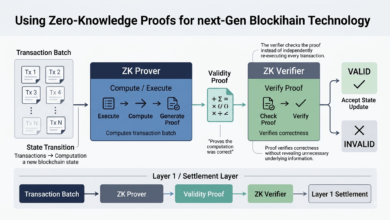


The simultaneous rise of artificial intelligence (AI) and blockchain technology represents one of the most compelling technological convergences of the digital era. Individually, both paradigms have disrupted major global industries. AI has radically transformed software capabilities through automated pattern recognition, natural language processing, and rapid predictive reasoning. Concurrently, blockchain has established a brand-new model for decentralized trust, immutable record-keeping, and peer-to-peer economic transfers without central intermediaries.
For years, discussions surrounding the merger of AI and blockchain were largely confined to academic whitepapers and speculative crypto-tech forums. However, as AI systems grapple with profound trust, attribution, and data provenance crises, and as blockchain networks seek enhanced automation and intelligent scaling mechanisms, their intersection has shifted from theoretical novelty to practical engineering necessity. Combining artificial intelligence with distributed ledgers creates a powerful synergy: AI provides the analytical engine, while blockchain delivers the secure, verifiable framework within which that engine can operate transparently.
This article explores the core principles of AI and blockchain integration, breaks down ten promising real-world and emerging use cases, analyzes key advantages and engineering challenges, and outlines the practical trajectory of this converging tech stack.
What Happens When AI Meets Blockchain?
To evaluate the potential of AI and blockchain integration, it is essential to analyze their foundational strengths and inherent architectural limitations. Rather than competing, the two technological stacks address opposing sides of the modern digital challenge.
| Core Dimension | Artificial Intelligence (AI) | Blockchain Technology |
| Primary Strength | Speed, automation, probabilistic reasoning, massive data analysis, adaptive pattern recognition. | Decentralization, deterministic execution, immutability, cryptographic verification, trustless ownership. |
| Inherent Vulnerability | “Black box” opacity, data bias, lack of origin tracking, hallucinations, vulnerable to centralized data silos. | Low throughput, limited native compute capacity, deterministic rigidity, lack of automated reasoning. |
| Integration Value | Injects dynamic logic, automated decision-making, and advanced predictive analytics into distributed protocols. | Provides tamper-proof data provenance, verifiable execution traces, and decentralized incentive layers for AI models. |
When combined, these two paradigms offset each other’s primary weaknesses. AI models require immense quantities of reliable, uncorrupted data to train effectively, alongside verifiable mechanisms to establish content origin. Blockchain offers an immutable audit trail that verifies where training data originated, who owns it, and whether it has been altered. Conversely, blockchain smart contracts are inherently rigid—they execute pre-programmed if/then logic but cannot independently adapt to ambiguous real-world inputs. AI introduces dynamic intelligence to these contracts, allowing them to evaluate complex inputs while retaining the verifiable execution guarantees of distributed ledgers.
10 Promising AI and Blockchain Use Cases
1. Decentralized AI Compute and Data Marketplaces (Status: Developing)
-
How it Works: Specialized blockchain protocols pool idle GPU compute capacity and private data sets from global contributors. Web3 smart contracts automatically match machine learning developers with hardware providers and dataset contributors, executing micro-payments via native tokens based on verifiable work performed.
-
Why Blockchain Adds Value: Eliminates centralized cloud provider lock-in, reduces infrastructure costs, establishes peer-to-peer data monetization, and guarantees cryptographically secure reward distribution.
-
How AI Contributes: Consumes distributed compute resources for model training and inference while utilizing diverse, decentralized datasets to reduce algorithmic bias.
-
Real-World Applications: Compute sharing networks (e.g., Render, Akash), decentralized AI training frameworks (e.g., Bittensor), and privacy-preserving data exchanges.
-
Limitations & Risks: Network latency during distributed model training, complex hardware verification, and price volatility in utility tokens.
2. AI-Powered Smart Contracts (Status: Developing)
-
How it Works: Smart contracts integrate external AI inferences via specialized cryptographic bridge frameworks known as AI Oracles. Instead of relying solely on static data triggers, smart contracts can react to predictive machine learning models.
-
Why Blockchain Adds Value: Enforces tamper-proof, deterministic execution of financial or operational agreements once the AI condition is satisfied.
-
How AI Contributes: Evaluates complex real-world data—such as dynamic credit risk, satellite imagery for parametric insurance claims, or cross-chain yield optimization—to trigger smart contract actions.
-
Real-World Applications: Automated DeFi risk management, automated insurance payouts for crop failure based on satellite weather data, dynamic NFT minting.
-
Limitations & Risks: Non-deterministic AI outputs can cause smart contract state conflicts; vulnerabilities in oracle infrastructure can be exploited.
3. Fraud Detection and Financial Security in Web3 (Status: Developing)
-
How it Works: Machine learning algorithms continuously scan public blockchain transaction graphs in real time, detecting suspicious patterns, wash trading, anomalous wallet interactions, and potential smart contract exploits before or as they occur.
-
Why Blockchain Adds Value: Provides a completely transparent, publicly accessible, historical ledger of all transactions, enabling training of highly accurate anomaly detection models.
-
How AI Contributes: Identifies subtle, complex multi-wallet money laundering patterns or exploit signatures across thousands of daily transactions faster than human auditors.
-
Real-World Applications: On-chain risk scoring platforms (e.g., Chainalysis, Elliptic), automated protocol pause mechanisms, exchange anti-money laundering (AML) compliance.
-
Limitations & Risks: Sophisticated attackers can adjust techniques to evade model detection; false positives can block legitimate user transactions.
4. Tokenization of AI Models and Training Data (Status: Experimental)
-
How it Works: AI model weights, proprietary algorithms, and curated training datasets are registered as digital assets on a blockchain (e.g., via non-fungible or fractional tokens). Developers monetize their intellectual property through fractional ownership and usage-based royalties.
-
Why Blockchain Adds Value: Provides transparent royalty distribution, verifiable ownership claims, and clear permission structures for intellectual property.
-
How AI Contributes: Generates underlying commercial value through specialized models, fine-tuned weights, and high-value domain datasets.
-
Real-World Applications: Open-source developer monetization, decentralized AI marketplaces (e.g., Ocean Protocol), crowdsourced medical training sets.
-
Limitations & Risks: Enforcing IP rights off-chain remains legally difficult; underlying training data may contain unauthorized copyrighted material.
5. Decentralized Physical Infrastructure Networks (DePIN) for AI (Status: Developing)
-
How it Works: DePIN protocols use crypto-economic incentives to encourage individuals to deploy physical hardware—such as edge compute nodes, IoT sensors, or ambient environmental monitors—creating decentralized infrastructure for AI operations.
-
Why Blockchain Adds Value: Coordinates global physical hardware deployment without centralized capital expenditure, using tokens to align participant incentives transparently.
-
How AI Contributes: Analyzes raw sensor data at the edge, optimizes network routing, and processes localized environmental inputs in real time.
-
Real-World Applications: Decentralized mapping networks (e.g., Hivemapper), distributed weather sensor arrays, edge-AI image recognition networks.
-
Limitations & Risks: High initial setup barriers for non-technical node operators; risk of spoofed data from bad actors seeking token rewards.
6. Supply Chain Intelligence and Verification (Status: Developing)
-
How it Works: IoT sensors attached to physical cargo record environmental variables (temperature, location, humidity) onto a blockchain ledger. AI algorithms process this flow of data to predict logistics delays, optimize routes, and verify product freshness.
-
Why Blockchain Adds Value: Creates a single, multi-party source of truth that prevents post-hoc tampering with transit history or quality logs.
-
How AI Contributes: Predicts disruptions, forecasts demand spikes, and automatically flags subtle deviations in temperature logs that indicate cargo spoilage.
-
Real-World Applications: Pharmaceutical cold-chain monitoring, luxury goods provenance tracking, food safety auditing.
-
Limitations & Risks: The “garbage-in, garbage-out” problem: physical hardware tampering at the source can compromise ledger integrity.
7. Healthcare Data Privacy and Collaborative AI (Status: Experimental)
-
How it Works: Medical institutions use Privacy-Preserving Technologies—such as Zero-Knowledge Proofs (ZKPs) and Federated Learning—to train clinical AI models across distributed patient records without removing raw medical data from local hospital servers.
-
Why Blockchain Adds Value: Manages granular patient consent permissions, records verifiable audit trails of model access, and distributes rewards for data usage.
-
How AI Contributes: Analyzes complex medical imaging and genomic records to discover diagnostic insights and assist drug discovery.
-
Real-World Applications: Multi-hospital rare disease research, private genomic analysis networks, cross-border clinical trial data sharing.
-
Limitations & Risks: Heavy computational overhead of combining ZKPs and federated learning; regulatory compliance hurdles (e.g., HIPAA, GDPR).
8. Decentralized Digital Identity and AI Personhood Verification (Status: Developing)
-
How it Works: Individuals maintain Self-Sovereign Identity (SSI) profiles using decentralized identifiers (DIDs) and zero-knowledge credentials. These credentials verify that a user is a unique human without disclosing personal identity attributes.
-
Why Blockchain Adds Value: Provides a decentralized trust anchor for identity credentials without reliance on centralized identity providers like Google or Meta.
-
How AI Contributes: AI anti-sybil algorithms analyze behavioral biometrics and interaction patterns while combating sophisticated AI bot networks.
-
Real-World Applications: Bot-resistant digital voting, proof-of-personhood protocols (e.g., World Network / World ID), secure online authentication.
-
Limitations & Risks: Biometric privacy concerns, potential centralized hardware vectors, user friction in credential management.
9. Autonomous AI Agents and On-Chain Micro-Transactions (Status: Experimental)
-
How it Works: Autonomous AI software agents are provisioned with self-custodial cryptographic wallets. Agents independently negotiate, pay for services, purchase API credits, or hire other specialized agents using smart contracts and stablecoins.
-
Why Blockchain Adds Value: Autonomous software agents cannot open traditional bank accounts or hold credit cards. Blockchain provides frictionless, permissionless financial rails native to code.
-
How AI Contributes: Executes complex multi-step reasoning, goal-oriented decision making, resource allocation, and automated negotiation.
-
Real-World Applications: Machine-to-machine data purchasing, automated arbitrage agents, decentralized AI service swarms.
-
Limitations & Risks: Infinite loop execution risks leading to fund exhaustion; unexpected agent behaviors under volatile market conditions.
10. Content Authenticity, Media Verification, and Watermarking (Status: Developing)
-
How it Works: Digital media creation tools cryptographically sign content at the moment of capture or generation. The media signature and metadata hash are registered on a blockchain, creating an immutable history of edits and ownership.
-
Why Blockchain Adds Value: Delivers an unalterable, publicly queryable timestamp and ownership trail that proves digital media origin.
-
How AI Contributes: Generates content provenance metadata, detects deepfakes, and scans media networks for unauthorized copyright infringement.
-
Real-World Applications: Journalism source verification (e.g., C2PA standards combined with blockchain logs), deepfake mitigation, digital art provenance.
-
Limitations & Risks: Widespread adoption requires deep integration across hardware camera manufacturers and publishing platforms.
Key Benefits of AI and Blockchain Convergence
Integrating artificial intelligence with blockchain technology delivers fundamental structural benefits that address key operational vulnerabilities in modern enterprise systems:
-
Enhanced Transparency and Verifiability: Every action taken by an automated system—or dataset used to train a model—can be logged onto a tamper-proof ledger, enabling transparent third-party auditing.
-
Data Provenance and Lineage Tracking: Blockchain records establish clear lineage for digital assets and training sets, helping curb copyright disputes and verifying raw data sources.
-
Disintermediation and Cost Reduction: Peer-to-peer compute and data networks bypass costly corporate intermediaries, returning value directly to resource contributors and model creators.
-
Proactive Fraud Prevention: Automated on-chain machine learning detects financial exploits and unauthorized protocol interactions in real time.
-
New Monetization Frameworks: Granular tokenization allows developers and researchers to monetize fine-tuned weights, niche datasets, and specialized AI models at microscopic scale.
Challenges, Bottlenecks, and Risks
Despite significant technical promise, the integration of AI and blockchain faces formidable engineering and regulatory obstacles that must be overcome before mainstream adoption occurs.
Critical Technical Trade-off: Blockchains are deliberately designed for deterministic consistency and maximum security, making them inherently slow and computationally constrained. Conversely, modern deep learning AI relies on massive non-deterministic compute parallelism. Harmonizing these two paradigms without compromising security or speed remains an engineering hurdle.
-
Scalability and Computational Costs: Storing heavy machine learning models or executing complex inferences directly on-chain is cost-prohibitive. Systems must rely on off-chain computation coupled with Zero-Knowledge Machine Learning (zkML) proofs.
-
Data Privacy versus Transparency: Public blockchains broadcast data across all participating nodes. Combining this with sensitive AI training data (e.g., patient records) requires advanced cryptography like Homomorphic Encryption or Zero-Knowledge Proofs, which introduce computational latency.
-
AI Hallucinations and Smart Contract Rigidity: Smart contracts execute unconditionally. If an AI Oracle feeds an erroneous or “hallucinated” inference to a smart contract, it can trigger irreversible financial loss.
-
Regulatory Uncertainty: The intersection of crypto-assets, autonomous software agents, and AI intellectual property operates in a rapidly shifting global regulatory landscape, creating hesitation for enterprise adoption.
-
Risk of Centralization in Decentralized Systems: Many current “decentralized AI” protocols rely on centralized cloud backends (e.g., AWS) for underlying hardware, creating a single point of failure under the surface.
Future Outlook
Over the next decade, the convergence of AI and blockchain will likely transition from experimental hybrid systems to foundational infrastructure for the digital economy. The most critical trend to monitor is the rise of autonomous AI agents operating within Web3 rails. As software agents take on complex economic tasks—such as managing treasury yields, negotiating supply procurement, or purchasing micro-services—permissionless distributed ledgers will serve as their native banking layer.
Furthermore, the maturation of Zero-Knowledge Machine Learning (zkML) will enable lightweight verification of heavy AI computations off-chain, bringing provable, un-tampered AI inference into smart contracts without high gas fees. Simultaneously, standard organizations and news outlets will increasingly rely on blockchain-backed cryptographic watermarking to preserve media integrity against generative deepfakes.
The integration of AI and blockchain is not about combining two trending technologies for marketing cachet. It is an engineering response to real limitations in both fields. AI needs decentralized verification, data privacy, and transparent origin tracking. Blockchain needs adaptive intelligence, automated transaction management, and enhanced user experiences.
While experimental implementations continue to navigate challenges in throughput, latency, and regulation, the most practical use cases—such as fraud detection, decentralized compute sharing, and verifiable content provenance—are already establishing tangible value. Successful long-term adoption will depend on solving real engineering problems rather than relying on speculative hype.