

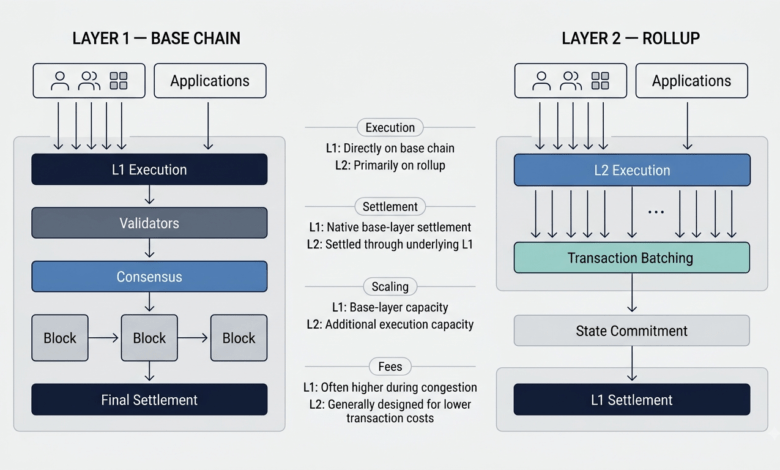
The blockchain landscape in 2026 has moved past speculative arguments about block size and throughput limits. The market has matured into a multi-layered infrastructure stack where base networks (Layer 1s) and scaling environments (Layer 2s) serve distinct economic roles.
For years, analysts framed the battle as a zero-sum war: would monolithic high-throughput L1s render scaling layers obsolete, or would Layer 2 rollups absorb all on-chain activity and hollow out L1 economic models?
As of August 2026, the data reveals a far more nuanced reality. “Winning” in Web3 is no longer a single category. Ethereum continues to dominate institutional settlement and total liquidity, while Solana leads in retail execution speed and raw trading volume. Concurrently, Layer 2 platforms—led by Base and Arbitrum—now handle the majority of daily consumer and developer transactions within the Ethereum ecosystem.
This report provides a data-driven evaluation of Layer 1 vs Layer 2 networks in 2026, breaking down capital allocation, throughput, technical architecture, and real-world adoption to determine which networks are leading across key metrics.
What Are Layer 1 and Layer 2 Blockchains?
Understanding the distinction between Layer 1 (L1) and Layer 2 (L2) is vital for analyzing modern blockchain performance.
       +-------------------------------------------------------------+
       |                     LAYER 2 NETWORKS                        |
       |     (Execution Layer: High Throughput, Sub-Cent Fees)        |
       |  Base   |   Arbitrum   |   OP Mainnet   |   zkSync Era      |
       +------------------------------+------------------------------+
                                      | Batch State Commitments
                                      | & Proofs (Data Availability)
                                      v
       +-------------------------------------------------------------+
       |                     LAYER 1 NETWORK                         |
       |     (Settlement, Consensus, Data Availability, Security)    |
       |                       ETHEREUM L1                           |
       +-------------------------------------------------------------+
Layer 1: The Base Settlement Infrastructure
A Layer 1 blockchain is an independent, primary consensus network. It is fully responsible for its own consensus mechanism (e.g., Proof-of-Stake), state execution, transaction ordering, and data availability. L1s function as root ledgers of trust.
-
Examples: Ethereum, Solana, BNB Chain, Sui, Avalanche.
Layer 2: Scalable Execution Environments
A Layer 2 protocol operates on top of an underlying L1. Its main function is to offload execution—processing dozens of transactions off-chain at low cost—while bundling these transactions into batches and settling them back on the base L1. By posting transaction data or validity proofs to the L1, an L2 inherits the fundamental security and finality of the parent network.
-
Examples: Base, Arbitrum One, OP Mainnet, zkSync Era, Starknet.
Technical Architecture Variations Among L2s
Not all L2 scaling designs are identical:
-
Optimistic Rollups: Assume state updates are valid by default. They utilize a fraud-proof window (typically 7 days) during which network participants can challenge fraudulent transactions.
-
Zero-Knowledge (ZK) Rollups: Use cryptographic validity proofs (SNARKs or STARKs) to mathematically confirm the correctness of off-chain batches instantly upon verification on L1.
-
Validiums & Optimiums: Offload data availability to off-chain data availability committees (DACs) or specialized layers (like EigenDA or Celestia) to reduce costs further, trading a minor degree of security for higher data throughput.
Which Layer 1 Networks Are Winning in 2026?
1. Ethereum
-
Layer: L1
-
Architecture: Monolithic Proof-of-Stake (PoS) serving as the global L2 settlement engine.
-
Current 2026 Position: Dominates institutional liquidity, secured assets, and stablecoin issuance.
-
Key Metrics (Aug 2026): ~$41.0B DeFi TVL; over 70% of global stablecoin float; >35.8M ETH staked across 1.1M active validators.
-
Strengths: Maximum economic security, highest decentralization profile, deep institutional integration (RWA assets, spot ETFs).
-
Weaknesses: Layer 1 execution capacity remains constrained (~15–20 TPS), requiring retail users to navigate to L2s to avoid fees.
-
Main Use Cases: Global asset settlement, institutional custody, sovereign DeFi base layer.
-
2026 Momentum: Stable capital retention; gas fees on mainnet remain low (~0.1 Gwei average) due to L2 rollup batching.
-
Verdict: Undisputed market leader for high-value settlement and deep liquidity.
2. Solana
-
Layer: L1
-
Architecture: Monolithic Proof-of-History (PoH) combined with PoS for high parallel execution.
-
Current 2026 Position: Premier destination for high-frequency trading, consumer dApps, and retail activity.
-
Key Metrics (Aug 2026): ~$5.5B DeFi TVL; ~$2.84B average daily DEX volume; ~2.4M daily active addresses.
-
Strengths: Sub-second block times, low transaction fees, single global execution state.
-
Weaknesses: High hardware requirements for full nodes; validator consolidation relative to Ethereum.
-
Main Use Cases: Retail DEX trading, consumer social dApps, micropayments, high-frequency DeFi.
-
2026 Momentum: Strong growth in DEX volume and retail user expansion, backed by spot Solana ETFs.
-
Verdict: The leading alternative high-throughput L1.
3. BNB Chain
-
Layer: L1
-
Architecture: Proof-of-Staked Authority (PoSA).
-
Current 2026 Position: Retains a large retail user base due to Binance ecosystem integration.
-
Key Metrics (Aug 2026): ~$4.8B DeFi TVL; high daily active user counts.
-
Strengths: Low transaction costs, massive exchange distribution channel.
-
Weaknesses: Higher centralization risk due to limited permissioned validator set.
-
Main Use Cases: Retail swaps, Web3 gaming, meme tokens, cross-border payments.
-
2026 Momentum: Moderate; faces stiff competition from Ethereum L2s like Base.
-
Verdict: A dominant retail network, though facing structural pressure from decentralized rollups.
4. Sui
-
Layer: L1
-
Architecture: Object-centric Move VM with parallel execution engines.
-
Current 2026 Position: Rapidly growing alternative L1 focused on developer experience and latency.
-
Key Metrics (Aug 2026): ~$1.1B DeFi TVL; sustained developer adoption growth.
-
Strengths: High execution speed, parallel state processing, strong object-oriented programming model.
-
Weaknesses: Smaller institutional liquidity pool compared to Ethereum.
-
Main Use Cases: On-chain gaming, real-time DeFi, dynamic non-fungible digital assets.
-
2026 Momentum: Positive upward trajectory in developer activity and gaming dApps.
-
Verdict: Strong technological contender among modern non-EVM L1s.
5. Avalanche
-
Layer: L1
-
Architecture: Multi-chain Snow consensus operating across Primary Network and custom Subnets.
-
Current 2026 Position: Specialized hub for custom enterprise chains and financial institution subnets.
-
Key Metrics (Aug 2026): ~$950M C-Chain TVL; expanding subnet enterprise TVL.
-
Strengths: Fast sub-second finality, customizable subnet compliance rules.
-
Weaknesses: Primary chain retail activity has shifted toward alternative L1s and L2s.
-
Main Use Cases: Institutional tokenization, specialized enterprise blockchains, custom gaming subnets.
-
2026 Momentum: Stable enterprise traction; shifting focus toward permissioned institutional rails.
-
Verdict: Leading institutional subnet framework.
Which Layer 2 Networks Are Winning in 2026?
1. Base
-
Layer: L2
-
Type: Optimistic Rollup (OP Stack architecture).
-
Underlying L1: Ethereum.
-
Current TVS (Aug 2026): ~$11.6B Total Value Secured (L2BEAT).
-
Activity: >12M daily transactions; accounts for ~37% of all L2 transaction throughput.
-
Strengths: Coinbase ecosystem distribution, embedded Smart Wallet onboarding, primary hub for agentic payment protocols (e.g., x402).
-
Weaknesses: Sequencer remains centralized under single-operator control.
-
Main Use Cases: Consumer applications, AI agent micro-transactions, social protocols, retail swaps.
-
2026 Momentum: Fastest-growing L2 by user adoption and transaction volume.
-
Verdict: The leading L2 for consumer distribution and overall transactional volume.
2. Arbitrum One
-
Layer: L2
-
Type: Optimistic Rollup (Nitro execution, BoLD fraud proof system).
-
Underlying L1: Ethereum.
-
Current TVS (Aug 2026): ~$15.5B Total Value Secured (L2BEAT).
-
Activity: Deepest L2 capital efficiency, ~$1.56B in protocol DeFi TVL, ~$4.2B stablecoin float.
-
Strengths: Stage 1 permissionless fraud proofs live via BoLD, deep institutional backing (Robinhood Arbitrum Orbit Chain).
-
Weaknesses: Retail social engagement lags slightly behind Base.
-
Main Use Cases: High-capital DeFi protocols, perpetual trading, institutional asset rails.
-
2026 Momentum: Maintained dominant capital lead in L2 DeFi assets.
-
Verdict: The premier Layer 2 for institutional capital depth and security maturity.
3. OP Mainnet (and the Superchain)
-
Layer: L2
-
Type: Optimistic Rollup (OP Stack standard engine).
-
Underlying L1: Ethereum.
-
Current TVS (Aug 2026): ~$1.3B TVS on standalone OP Mainnet; >$15B across the combined Superchain ecosystem.
-
Activity: Multi-chain inter-rollup message routing.
-
Strengths: Standardized framework adopted by Base, Kraken (Ink), Uniswap (Unichain), and Celo.
-
Weaknesses: Direct OP Mainnet chain usage is outpaced by Base.
-
Main Use Cases: Open-source infrastructure standards, shared sequencer pools, cross-rollup interoperability.
-
2026 Momentum: Strong growth as an enterprise framework standard.
-
Verdict: The foundation of the Superchain ecosystem.
4. zkSync Era
-
Layer: L2
-
Type: Zero-Knowledge Rollup (zkEVM).
-
Underlying L1: Ethereum.
-
Current TVS (Aug 2026): ~$350M TVS (L2BEAT).
-
Activity: Moderate settlement activity; strong native paymaster and account abstraction usage.
-
Strengths: Immediate cryptographic validity proofs, native paymaster UX.
-
Weaknesses: Capital liquidity has concentrated into optimistic alternatives.
-
Main Use Cases: Privacy-focused financial applications, fast-settlement payment rails.
-
2026 Momentum: Moderate; technical sophistication high, but liquidity growth remains competitive.
-
Verdict: Leading ZK-EVM implementation facing stiff competition from optimistic rollups.
Ethereum vs Solana vs Other Leading L1s
The narrative of “Ethereum vs. Solana” has shifted in 2026. Data confirms that both networks are succeeding, but they are serving different roles.
+-------------------------------------------------------------------------+
|                      THE LAYER 1 SPECTRUM (2026)                        |
|                                                                         |
|   HIGH LIQUIDITY & SECURITY                    HIGH THROUGHPUT & UX     |
|   <----------------------------------------------------------------->   |
|   Ethereum Mainnet                                     Solana           |
|   - $41.0B DeFi TVL                                    - 2.4M Active DAUs|
|   - Global Settlement Layer                            - $2.84B Daily DEX |
|   - Institutional Capital                              - Retail & HFT   |
+-------------------------------------------------------------------------+
Ethereum: The Global Settlement Engine
Ethereum operates primarily as the capital and settlement anchor of the decentralized economy. While mainnet handles a modest 15–20 transactions per second, its total capital secured—comprising $41.0B in DeFi TVL and hundreds of billions in ERC-20 stablecoins—far exceeds all competing L1s combined. Ethereum is where institutions store value, secure asset issuance, and finalize state changes.
Solana: The High-Frequency Trading & Execution Engine
Solana has established itself as the execution layer of choice for retail users, memecoins, and high-frequency trading. With daily DEX volume reaching $2.84B and active address counts fluctuating between 2M and 5M daily, Solana frequently outpaces Ethereum mainnet in day-to-day user activity metrics. However, its total TVL (~$5.5B) remains roughly 13% of Ethereum’s L1 TVL, demonstrating that user address volume does not correlate linearly with deep institutional liquidity.
Base vs Arbitrum vs Optimism vs Other Major L2s
Data from L2BEAT and 21Shares highlights a sharp power-law distribution in the L2 landscape: over 90% of all Layer 2 user activity and value is concentrated within Base, Arbitrum, and the OP Stack ecosystem.
-
Base vs Arbitrum: Arbitrum commands the highest capital security ($15.5B TVS vs. Base’s $11.6B TVS). However, Base commands raw daily throughput, generating over 12 million transactions daily due to seamless integration with Coinbase’s exchange fiat rails.
-
The OP Superchain Advantage: Optimism’s OP Mainnet records lower direct TVS ($1.3B), but its underlying stack powers Base, Ink (Kraken), Unichain (Uniswap), and Celo. When evaluated collectively, the Superchain ecosystem locks tens of billions in total value.
-
ZK Rollup Position: zkSync Era and Starknet offer superior cryptographic finality and native account abstraction. However, optimistic rollups currently hold an estimated 80%+ market share of L2 assets due to simpler EVM equivalence and earlier liquidity consolidation.
What Metrics Actually Matter?
Evaluating blockchains based on market cap or single metrics creates distorted conclusions. A holistic benchmark requires breaking down what each metric measures:
-
TVL (Total Value Locked): Measures the capital actively deployed in smart contracts (lending pools, automated market makers). Limitation: Can be inflated by governance token leverage or double-counting synthetic assets.
-
TVS (Total Value Secured): Utilized by L2BEAT to measure all assets bridged to, natively issued on, or secured by a Layer 2 rollup. Unlike DeFi TVL, TVS reflects total asset security backstop.
-
Raw Transaction Counts: Measures overall execution events. Limitation: Extremely low-cost chains can fabricate high TPS through bot transactions and validator ping-pongs.
-
Active Addresses: Captures operational unique wallets interacting with smart contracts daily. Limitation: One human user or automated trading bot can control thousands of addresses simultaneously.
-
DEX Volume: Indicates real economic velocity and asset swaps. Higher DEX volume translates directly to protocol fee generation and arbitrage efficiency.
-
Stablecoin Supply: Evaluates ecosystem liquidity depth. Networks with high stablecoin issuance (e.g., Ethereum’s >$100B float) function as reliable financial settlement layers.
L1 vs L2 Economics
The economic engine driving Layer 1 vs Layer 2 networks centers on value capture and cost structure.
+-------------------------------------------------------------------+
|                        L2 VALUE FLOW STACK                        |
|                                                                   |
|   1. User pays low execution fee to L2 Sequencer ($0.005 - $0.02) |
|                                |                                  |
|                                v                                  |
|   2. L2 Sequencer processes & batches transactions                |
|                                |                                  |
|                                v                                  |
|   3. Sequencer pays L1 Blob Space Fee to Ethereum Mainnet         |
|                                |                                  |
|                                v                                  |
|   4. L2 Sequencer keeps Net Margin (Sequencer Revenue)            |
+-------------------------------------------------------------------+
-
User Fees: Users pay fees to the L2 sequencer for rapid transaction execution (typically $0.001 to $0.05).
-
Data Availability (DA) Expenses: Rollups must post transaction batches or state diffs to their underlying L1 (or specialized DA layers like Celestia) using blob space (introduced in EIP-4844).
-
Sequencer Revenue: The net difference between fees collected from L2 users and the batch submission cost paid to L1 validators represents the L2 sequencer’s profit margin.
-
L1 Settlement Demand: As hundreds of L2 rollups scale, competition for L1 settlement guarantees consistent underlying baseline demand for mainnet ETH execution and blob storage fees.
The Layer 2 Paradox: Helping Ethereum or Competing With It?
A core debate in Web3 research centers on whether L2s augment Layer 1s or cannibalize their revenue.
The Bull Case for L2 Ecosystem Growth
-
Capacity Expansion: L2s expand Ethereum’s execution capacity from 15 TPS to thousands of combined transactions per second across the rollup ecosystem.
-
Cost Reduction: Brings execution fees down by 90-99%, unlocking micro-transactions, gaming, and AI agent rails that were unfeasible on mainnet.
-
Network Effects: L2s lock assets within the broader Ethereum security framework, preventing user flight to competing L1 platforms.
The Bear Case for L1 Fee Cannibalization
-
Revenue Fragmentation: Mainnet execution fees dropped significantly as user activity migrated to Layer 2s, reducing burn rates of base L1 assets.
-
Liquidity Fragmentation: Capital split across dozens of distinct L2 rollups creates fragmented liquidity pools and complex cross-chain user experiences.
Conclusion on the Paradox: L2s do not act as zero-sum competitors; they serve as Ethereum’s front-end consumer interface, transforming L1 Ethereum into an enterprise-grade clearance and settlement layer.
Security and Decentralization
Network security models determine how well an ecosystem can resist censorship, state manipulation, or operational outages:
+---------------------------------------------------------------------+
|                      SECURITY SPECTRUM (2026)                       |
|                                                                     |
|  HIGHEST SETTLEMENT ASSUMPTIONS         CENTRALIZED SEQUENCER RISKS |
|  <--------------------------------------------------------------->  |
|  Ethereum L1              Arbitrum (BoLD)             Base / OP     |
|  - 1.1M Validators        - Stage 1 Rollup            - Stage 0     |
|  - Distributed Consensus   - Open Fraud Proofs         - Centralized |
+---------------------------------------------------------------------+
-
Ethereum L1: Possesses the strongest consensus security in Web3, backed by 1.1M active validators and over 35 million staked ETH.
-
Arbitrum One: Leads L2 security standards as an L2BEAT Stage 1 rollup. Its Bounded Liquidity Delay (BoLD) protocol allows permissionless fraud-proof submission, mitigating single-sequencer state corruption risks.
-
Base & OP Mainnet: Currently operate with centralized sequencers managed by core teams. While asset withdrawal backstops revert to Ethereum L1, reliance on single sequencers introduces temporary single-point-of-failure risks during outages.
DeFi and Stablecoin Leaders
DeFi activity requires deep liquidity, collateral stability, and protocol integration:
-
Total Value Locked (DeFi): Ethereum Mainnet dominates with ~$41.0B TVL, followed by Arbitrum ($1.56B in protocol TVL) and Solana (~$5.5B TVL).
-
Stablecoin Liquidity: Ethereum processes over 70% of global stablecoin value, with Arbitrum hosting ~$4.2B and Solana managing ~$14B. High stablecoin supply ensures low slippage for institutional traders.
-
Automated Market Makers & Lending: Uniswap and Aave maintain dominant positions across Ethereum and Arbitrum, while Aerodrome commands trading liquidity on Base, and Raydium/Kamino lead on Solana.
Consumer Adoption
Consumer adoption in 2026 favors platforms offering low fees and frictionless account abstraction:
-
Base: Winning consumer onboarding due to Coinbase integration and embedded passkey wallets. Base processes over 12 million transactions daily, largely driven by social applications (Farcaster), micro-tipping, and AI-driven automated agent transactions via the x402 payment protocol.
-
Solana: Leads retail engagement for instant trading, mobile dApps (Saga ecosystem), and consumer loyalty programs.
Institutional Adoption
Institutions prioritize regulatory clarity, security, and proven operational history:
-
Real-World Asset (RWA) Tokenization: Ethereum mainnet and Arbitrum hold the largest market share of tokenized U.S. Treasuries, money market funds (e.g., BlackRock’s BUIDL, Franklin Templeton), and institutional cash management tools.
-
Institutional Custom Chains: Robinhood launched its testnet for tokenized stock settlement using an Arbitrum Orbit L2 chain, while Kraken introduced its Ink L2 on the OP Stack.
Blockchain Winners of 2026 So Far
+-------------------------------------------------------------------+
|                     2026 CATEGORY WINNERS                         |
|                                                                   |
|   - Best L1 Ecosystem:        Ethereum Mainnet                    |
|   - Best L2 Ecosystem:        Base                                |
|   - Best DeFi Network:        Arbitrum One                        |
|   - Best Consumer Network:    Solana                              |
|   - Best Institutional Rail:  Ethereum L1                         |
|   - Most Improved Scaling:    Base (OP Stack)                     |
+-------------------------------------------------------------------+
-
Best L1 Ecosystem: Ethereum (Unmatched capital security, validator decentralization, and institutional integration).
-
Best L2 Ecosystem: Base (Dominant user growth, daily throughput, and consumer application distribution).
-
Best DeFi Network: Arbitrum One (Deepest L2 capital liquidity, robust protocol TVL, and permissionless fraud proofs).
-
Best Consumer Network: Solana (Superior throughput for low-latency trading, payments, and active retail addresses).
-
Best Institutional Rail: Ethereum L1 (Primary destination for spot ETFs, corporate treasuries, and RWA tokenization).
-
Most Improved Network: Base (Expanded from an emerging L2 to rivaling Arbitrum in total value secured within 18 months).
Final L1 Ranking
-
Ethereum: Undisputed #1 in settlement capital, security, and developer ecosystem.
-
Solana: Premier high-throughput L1 for retail execution and DEX trading.
-
BNB Chain: Strong retail presence backed by exchange distribution channels.
-
Sui: Top-performing modern non-EVM parallelized execution environment.
-
Avalanche: Leading specialized architecture for enterprise custom subnets.
Final L2 Ranking
-
Base: Leading L2 by consumer daily transactions, active wallets, and social ecosystem integration.
-
Arbitrum One: Top L2 by Total Value Secured ($15.5B TVS) and DeFi liquidity depth.
-
OP Mainnet: Essential hub anchoring the expanding multi-chain Superchain architecture.
-
zkSync Era: Leading ZK-EVM bringing cryptographic validity proofs to mainstream applications.
-
Starknet: Differentiated high-performance ZK-rollup tailored for novel execution logic.
Are L1s or L2s Winning Overall?
Rather than one replacing the other, 2026 marks an era of ecosystem convergence. Layer 1s serve as high-security settlement ledgers, while Layer 2s handle consumer throughput, low-cost execution, and app scaling. Ethereum’s modular expansion strategy has succeeded in capturing both security settlement and L2 transaction growth.
What Could Change the Rankings Before the End of 2026?
-
Sequencer Decentralization: If Base or OP Mainnet successfully roll out decentralized sequencer networks, their security profiles will challenge Arbitrum’s current lead.
-
ZK-Proof Efficiency Gains: Advances in real-time ZK-proving could lower execution costs for ZK rollups, shifting liquidity away from optimistic rollups.
-
AI Agent Payment Rails: Continued expansion of protocol standards like x402 could drive massive transaction volumes to L2 networks equipped with native account abstraction.
-
Regulatory Developments: Shifts in global staking regulatory rules could alter institutional deployment across L1 PoS networks.
FAQ
What is the difference between Layer 1 and Layer 2?
A Layer 1 network is an independent, base blockchain (like Ethereum or Solana) responsible for its own consensus and settlement. A Layer 2 network is a scaling layer built on top of an L1 that executes transactions off-chain to reduce fees while settling state updates back to the parent L1 for security.
Which Layer 1 is leading in 2026?
Ethereum remains the leading L1 by Total Value Locked (~$41.0B) and capital security, while Solana leads in daily active address interaction and retail DEX volume.
Which Layer 2 is leading in 2026?
It depends on the metric: Arbitrum One leads in Total Value Secured ($15.5B TVS) and DeFi capital depth, whereas Base leads in daily transaction count (>12M daily) and consumer app onboarding.
Is Base the biggest Ethereum L2?
Base is the largest Ethereum L2 by daily transaction volume and active user addresses, and briefly surpassed Arbitrum in TVS during Q2 2026. Arbitrum continues to hold the overall lead in total secured DeFi capital.
Is Arbitrum still a major L2?
Yes. Arbitrum One secures ~$15.5B in total assets and remains the primary choice for deep-liquidity DeFi applications and institutional rails like Robinhood’s Orbit chain.
Are Layer 2 networks replacing Ethereum?
No. Layer 2 networks rely on Ethereum for data availability, settlement, and ultimate security. Rather than replacing Ethereum, L2s reinforce mainnet as the foundational settlement engine of Web3.
Which blockchain has the strongest DeFi ecosystem?
Ethereum Mainnet holds the largest share of total DeFi value (~$41.0B), with Arbitrum dominating L2-based DeFi and Solana leading high-velocity retail trading.
Which blockchain has the strongest consumer adoption?
Base and Solana lead consumer adoption in 2026. Base benefits from seamless onboarding via Coinbase tools, while Solana offers low-latency execution for mobile and social applications.
Investment Disclaimer
This article is for informational and educational purposes only and does not constitute financial, investment, legal, or tax advice. Cryptocurrency markets and blockchain ecosystems are highly volatile. On-chain metrics, network throughput, and total value locked are time-sensitive indicators that do not guarantee token price performance. Readers should conduct independent research and consult certified financial advisors before making investment decisions.
The evolution of Layer 1 vs Layer 2 blockchains in 2026 demonstrates that the Web3 ecosystem is expanding through specialization. Monolithic Layer 1 networks like Ethereum provide an immutable, high-security bedrock for global capital settlement, while high-throughput L1s like Solana capture high-frequency trading and retail activity. Concurrently, Layer 2 scaling solutions—led by Base and Arbitrum—have successfully absorbed consumer throughput, delivering sub-cent transactions without sacrificing Ethereum’s baseline security.
Rather than a winner-take-all outcome, 2026 marks the consolidation of a multi-layered infrastructure stack where base-layer security and Layer 2 execution work in tandem to support the next era of decentralized finance and consumer applications.