
Imagine buying a slice of a $100 million skyscraper in Manhattan with the ease of purchasing a book online, earning monthly rental income directly to your digital wallet, and selling that share within minutes at any time of day.
For decades, investing in high-value real-world assets (RWAs) like commercial property, private equity, or government bonds was reserved for institutional players and ultra-wealthy individuals. These markets were historically bogged down by steep minimum investment requirements, lengthy settlement times, expensive intermediaries, and severe illiquidity.
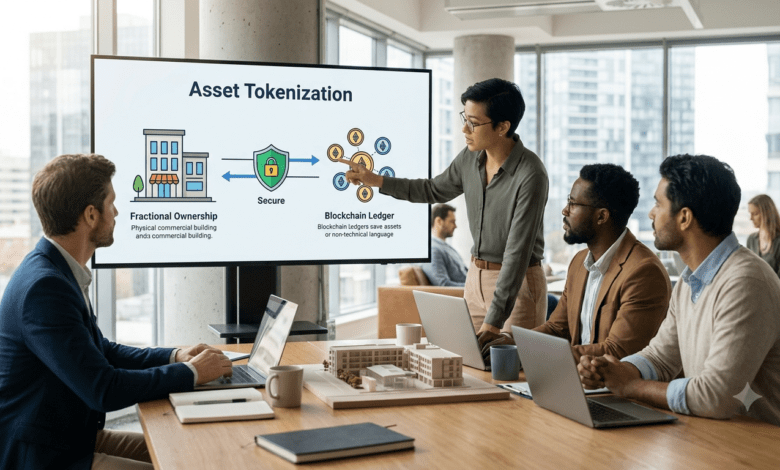
Today, asset tokenization—the process of converting rights to a physical or financial asset into a digital token on a blockchain—is fundamentally rewriting the rules of ownership. By bridging traditional finance (TradFi) with distributed ledger technology, tokenization is democratizing access to high-yield asset classes, unlocking multi-trillion-dollar liquidity pools, and modernizing global market infrastructure.
What Is Asset Tokenization?
At its core, asset tokenization is the process of creating a digital representation of a real-world asset on a secure, decentralized blockchain ledger.
When an asset is tokenized, its legal rights, economic value, and ownership terms are encoded into a programmable digital token. Each token represents a proportional share or claim on the underlying asset.
+------------------------+      +--------------------------+      +------------------------+
|  Real-World Asset      | ---> |  Legal Structure (SPV)   | ---> |  Digital Tokens        |
|  (e.g., Real Estate,   |      |  Holds legal title to    |      |  Minted on blockchain  |
|   Bonds, Art, Equity)  |      |  the physical asset      |      |  representing shares   |
+------------------------+      +--------------------------+      +------------------------+
Digital Representation vs. Physical Ownership
Rather than transferring physical paper deeds, share certificates, or centralized database entries, tokenization uses smart contracts—self-executing code stored on the blockchain—to execute transactions automatically when predefined conditions are met. Owning a token confers verified economic rights, such as rental dividend distributions, equity growth, or bond yield payouts.
Tokenized Assets vs. Cryptocurrencies
It is crucial to distinguish tokenized real-world assets from native cryptocurrencies:
-
Cryptocurrencies (e.g., Bitcoin, Ethereum): Digital native currencies without backing from physical assets. Their market value is driven primarily by supply, demand, network utility, and market sentiment.
-
Tokenized Assets (Digital Securities / RWAs): Digital representations of tangible or traditional financial assets—such as real estate, corporate bonds, treasury bills, or commodities. Their underlying value is anchored directly to the real-world performance, appraisal, or legal cash flow of the physical asset.
How Real Estate Tokenization Works
Real estate has long been the world’s largest asset class, yet it remains one of its most illiquid. Transforming a commercial office building, apartment complex, or residential portfolio into tradeable digital tokens involves a structured, legally sound process:
1. Asset Acquisition and SPV Formation
To bridge the physical world with the digital ledger, a legal entity—typically a Special Purpose Vehicle (SPV) like a Limited Liability Company (LLC)—is established. The SPV purchases and holds legal title to the property.
2. Legal Structuring and Compliance
The SPV issues equity or debt shares that correspond to ownership of the property. Legal agreements (such as operating agreements and private placement memorandums) are drafted to ensure that holding a digital token legally translates to holding a share in the SPV.
3. Smart Contract Development and Tokenization
Smart contracts are deployed on a public or permissioned blockchain (such as Ethereum, Avalanche, or Stellar). These contracts set the rules: total token supply, voting rights, dividend distribution intervals, and transfer restrictions (e.g., restricting trading exclusively to accredited or KYC-verified investors).
4. Investor Onboarding (KYC/AML)
Investors complete identity verification (Know Your Customer) and Anti-Money Laundering (AML) checks. Once approved, their wallet address is added to a permissioned “whitelist.”
5. Primary Issuance and Secondary Trading
Tokens are issued to investors during a primary funding round. Once distributed, investors receive rent distributions directly to their digital wallets via automated smart contracts. If allowed by regulators, tokens can then be traded on secondary digital asset exchanges, giving investors an exit option without forcing the sale of the physical property.
Benefits of Tokenizing Real Estate
Tokenized real estate introduces structural efficiencies that traditional paper-based real estate transactions cannot match:
-
Fractional Ownership: By splitting property equity into thousands or millions of digital tokens, high-value real estate can be fractionalized. An investor can buy $500 worth of a commercial tower rather than needing millions in capital.
-
Lower Investment Barriers: Fractionalization dramatically lowers entry minimums, allowing retail and accredited investors to build diversified real estate portfolios across regions and property types.
-
Near-Instant Settlement: Traditional property sales take 30 to 90 days due to manual title searches, escrow management, and bank processing. Blockchain transactions finalize in minutes or seconds.
-
Automated Compliance & Distributions: Smart contracts automatically enforce transfer restrictions, verify investor accreditation, and calculate/distribute rental income directly to token holders’ wallets without intermediary bank fees.
-
Enhanced Recordkeeping & Transparency: Every transaction, ownership transfer, and dividend payment is permanently recorded on an immutable ledger, drastically reducing title disputes and administrative fraud.
-
Potential Liquidity Improvements: While tokenization does not guarantee instant secondary buyers, it creates the market infrastructure necessary for 24/7 peer-to-peer trading and continuous price discovery.
How Tokenization Is Changing Traditional Finance
Beyond real estate, tokenization is modernizing mainstream financial market infrastructure across multiple asset classes:
                  +----------------------------------------------+
                  |           ASSET TOKENIZATION IN TRADFI       |
                  +----------------------------------------------+
                                         |
     +-------------------+---------------+---------------+-------------------+
     |                   |                               |                   |
+----+------------+ +----+------------+         +--------+-------+  +--------+-------+
| Government Bonds| | Private Equity  |         | Money Market   |  | Trade Finance  |
| & Fixed Income  | | & Venture Fund  |         | & Cash Assets  |  | & Credit       |
+-----------------+ +-----------------+         +----------------+  +----------------+
-
Bonds and Fixed Income: Tokenized debt instruments reduce issuing costs and automate coupon payments. Issuers can distribute micro-bonds directly to investors worldwide.
-
Private Equity & Venture Capital: Private market funds typically require a 7- to 10-year capital lockup. Tokenizing LP (Limited Partner) stakes allows early investors to sell fractional claims on secondary markets without disrupting the fund’s capital.
-
Money Market Funds & Cash Equilavents: Institutional asset managers are putting money market assets on-chain, allowing yields to accrue daily and enabling these tokens to be used as instant, 24/7 margin collateral in trading.
-
Collateral Management & Repo Markets: Financial institutions can move tokenized securities between balance sheets instantly to cover collateral calls, eliminating the friction of traditional multi-day settlement delays.
Why Financial Institutions Are Exploring Tokenization
The interest from major global banks, asset managers, and fintech firms is driven by tangible operational benefits:
-
Operational Cost Reduction: Automating clearing, settlement, corporate actions, and record-keeping removes manual back-office tasks, saving institutions billions annually.
-
24/7/365 Global Operations: Traditional financial markets operate on strict market hours and multi-day settlement cycles (T+1 or T+2). Blockchain networks operate continuously worldwide with immediate atomic settlement (T+0).
-
Unlocking Trapped Capital: Trillions of dollars remain tied up in illiquid, non-traded assets. According to research by Boston Consulting Group (BCG), the total market for tokenized illiquid assets is projected to reach $16 trillion by 2030.
-
Programmable Finance: Smart contracts allow financial instruments to react dynamically to market conditions—such as auto-executing margin calls, dividend distributions, or tax withholdings.
Tokenization vs. Traditional Asset Ownership
| Feature | Traditional Ownership | Tokenized Ownership |
| Minimum Investment | High (Often $50,000 to $1M+) | Very Low (e.g., $10 to $500) |
| Settlement Speed | Days to Months (T+1 to T+90) | Minutes or Seconds (T+0) |
| Trading Hours | Standard Business Hours | 24/7/365 Continuous |
| Recordkeeping | Centralized Databases, Paper Deeds | Distributed, Immutable Blockchain |
| Secondary Market | Illiquid, Complex OTC Brokers | Global Digital Asset Exchanges |
| Compliance Management | Manual Verification | Automated via Smart Contracts |
| Intermediaries | Heavy (Brokers, Escrow, Title) | Light (Code, Protocols, Custodians) |
Real-World Use Cases and Industry Developments
Tokenization is no longer a theoretical experiment; major institutions and platforms have moved to live, large-scale deployments:
Institutional Money Market Funds
-
BlackRock’s BUIDL Fund: In early 2024, BlackRock launched its USD Institutional Digital Liquidity Fund (BUIDL) on the Ethereum blockchain. Investing in U.S. Treasury bills and repo agreements, BUIDL pays daily yields back to institutional investors on-chain, growing into a multi-billion dollar fund.
-
Franklin Templeton (BENJI): Franklin Templeton introduced the FOBXX fund on public blockchains like Stellar and Polygon, allowing retail and institutional users to invest in tokenized U.S. government securities via a mobile app.
Commercial Real Estate Platforms
-
Platforms like Lofty, RealT, and Cityfunds allow investors to buy tokenized fractional shares in residential and commercial rental properties. Investors hold tokens that pay daily or weekly rental yields directly to digital wallets.
Sovereign & Corporate Debt
-
European Investment Bank (EIB): The EIB has issued several digital euro bonds on public and private blockchains, demonstrating instant cross-border settlement and automated coupon processing.
Challenges and Risks
While promising, tokenization faces significant structural and market hurdles:
-
Regulatory Uncertainty: Securities regulations vary widely by country. Determining whether a token is a security, commodity, or utility token requires complex legal navigation across borders.
-
Smart Contract Vulnerabilities: Software code can contain bugs or security vulnerabilities. If a smart contract is exploited, investor funds could be lost permanently.
-
Illiquidity Risk: Tokenizing an asset does not automatically guarantee a willing buyer on secondary markets. Without active market makers and deep trading volume, tokenized assets remain illiquid.
-
Valuation & Oracle Dependability: Token prices must reflect real-world values accurately. Blockchain smart contracts rely on third-party “oracles” to feed real-world property appraisals and interest rates on-chain, introducing potential points of failure.
-
Fragmentation & Interoperability: A lack of unified standards across competing blockchains (Ethereum, Avalanche, Solana, institutional private ledgers) can isolate liquidity pools.
The Role of Regulation
Regulation is the single most critical factor determining the pace of tokenization adoption:
To function legally, tokenized real-world assets must comply with existing financial regulatory frameworks:
-
United States: Tokenized RWAs are treated as securities and must comply with SEC rules (e.g., Regulation D, Regulation S, or Regulation A+ offerings).
-
European Union: The Markets in Crypto-Assets (MiCA) regulation and the EU DLT Pilot Regime provide clearer guidelines for trading financial instruments on distributed ledgers.
-
Asia-Pacific: Regulators in Singapore (MAS), Switzerland (FINMA), and the UAE (VARA) have created regulatory sandboxes and legal frameworks explicitly tailored to tokenized assets and digital securities.
Disclaimer: Tokenized asset offerings are subject to complex local laws. This information is for educational purposes and does not constitute financial, legal, or investment advice.
The Future of Tokenized Real-World Assets
Over the next five to ten years, tokenization is expected to shift from a novelty to standard financial market infrastructure:
-
Institutional Capital Integration: As regulatory frameworks mature, major global custody banks, pension funds, and sovereign wealth funds will move larger portions of their portfolios on-chain.
-
Cross-Chain Interoperability: Standardized cross-chain messaging protocols will enable tokenized assets to move seamlessly across public and private blockchains.
-
DeFi Integration: Tokenized real-world assets will increasingly serve as stable, yield-bearing collateral within decentralized finance (DeFi) protocols, bridging institutional capital with decentralized liquidity.
Tokenization represents a fundamental upgrade to how humanity records, transfers, and manages value. By converting real estate, fixed-income products, and traditional securities into programmable blockchain tokens, markets gain efficiency, lower investment minimums, and 24/7 settlement capabilities.
However, tokenization is not a silver bullet. Mass adoption will depend on harmonized global regulations, robust smart contract security, seamless interoperability, and institutional-grade custody solutions. As these pieces fall into place, tokenization will continue to transform real estate and traditional finance into a more open, liquid, and transparent global economy.