

Quick Stablecoin vs Traditional Payments Comparison
| Feature | Stablecoins | Bank Transfers (e.g., SWIFT) | Card Networks (e.g., Visa/Mastercard) |
| Settlement | Near-instant on-chain finality (seconds to minutes). | T+1 to T+3+ business days (correspondent network delay). | Real-time authorization; final interbank settlement takes 1–3 days. |
| Operating Hours | 24/7/365 continuous operation. | Restricted to bank operating hours and business days. | 24/7 consumer authorization; bank-side settlement during business hours. |
| Cross-Border Use | Globally borderless by design via blockchain rails. | High friction via complex correspondent banking chains. | Global acceptance, but incurs foreign exchange (FX) and cross-border markups. |
| Intermediaries | Low (Sender, wallet, blockchain validator/sequencer, recipient). | High (Originating bank, intermediary banks, central bank, receiving bank). | High (Merchant, acquiring bank, payment gateway, card network, issuing bank). |
| Fees | Network gas fees (variable by chain) plus exchange/off-ramp costs. | Flat wire transfer fees, intermediary deductions, and currency markups. | Merchant Discount Rate (1.5%–3.5%) plus cross-border interchange fees. |
| Reversibility | Irreversible upon blockchain consensus finality. | Reversible only through formal bank recall protocols. | Reversible through consumer dispute and chargeback mechanisms. |
| Consumer Protection | Self-custodial; limited built-in recourse against fraud/mistakes. | Robust statutory protections, deposit insurance, and fraud recovery. | Extensive zero-liability protection and chargeback guarantees. |
| Programmability | Native execution via smart contracts and automated logic. | None (requires external automation layers via open banking APIs). | Limited (e.g., automated recurring billing triggers). |
Note: Payment economics vary significantly by jurisdiction, transaction volume, corridor, provider, and underlying network infrastructure.
Introduction
Global financial infrastructure is undergoing a fundamental structural transition. For decades, international value transfer relied on a fragmented web of correspondent banks, clearing houses, and card networks built around traditional banking hours. Today, fiat-backed digital tokens operating on public and permissioned blockchains are moving from speculative trading tools into core payment infrastructure.
Driven by demand for real-time settlement, lower operational friction, and continuous liquidity, stablecoins and digital payments have become central to discussions among financial regulators, corporate treasurers, and global fintechs. While stablecoins present new efficiencies for cross-border trade, treasury management, and financial inclusion, they also introduce novel regulatory, operational, and systemic risks. Understanding their true impact requires evaluating both their structural capabilities and their practical limitations.
What Are Stablecoins?
Stablecoins are digital assets designed to maintain a stable value relative to a reference asset, most commonly a fiat currency such as the U.S. dollar. Unlike unbacked cryptocurrencies, which experience significant price volatility, stablecoins aim to provide the unit-of-account predictability required for commercial transactions.
The landscape consists of three primary architectural models, each carrying distinct operational and risk profiles:
-
Fiat-Backed Stablecoins: Issued by central entities that hold equivalent reserve assets—such as physical currency, central bank deposits, or short-term Treasury bills—in reserve accounts. Examples like Tether (USDT) and Circle’s USD Coin (USDC) dominate commercial usage.
-
Crypto-Backed Stablecoins: Decentralized structures collateralized by other cryptocurrencies. To buffer against underlying market volatility, these models employ over-collateralization, requiring users to lock up collateral value exceeding the minted stablecoin value.
-
Algorithmic Stablecoins: Uncollateralized or under-collateralized designs that rely on algorithmic supply adjustments and market incentives to maintain their target peg. These models carry heightened risk of structural failure during market stress.
How Stablecoin Payments Work
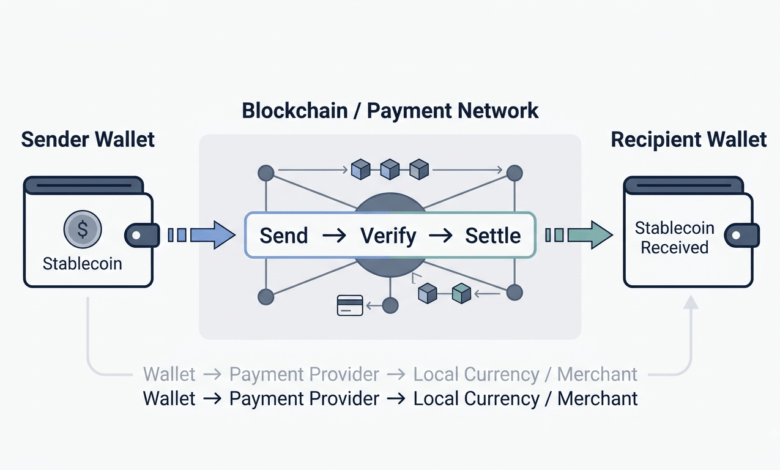
The basic flow of a consumer or business stablecoin payment follows a direct digital path:
-
Initiation: The sender approves a transfer of a specific stablecoin balance from a digital wallet.
-
Processing: The transaction is broadcast to the underlying blockchain network, where validators or sequencers verify account balances and record the state change.
-
Settlement: Once confirmed on-chain, final settlement occurs immediately, transferring direct ownership to the recipient’s wallet address.
-
Integration & Conversion: Recipients can retain the stablecoins within their treasury or convert them into local fiat currency via integrated banking off-ramps or payment service providers.
For enterprises, stablecoin integration occurs through specialized payment gateways and API layers that abstract away direct private-key management and automate regulatory compliance checks like Anti-Money Laundering (AML) and Know Your Customer (KYC) screening.
Why Stablecoins Could Change Digital Payments
The adoption of stablecoins for business and cross-border transactions stems from several key technical advantages over legacy settlement rails:
-
Continuous Settlement: Blockchains operate 24/7/365, removing dependence on central bank settlement windows, weekend cutoffs, or holiday delays.
-
Programmable Finance: Smart contracts allow payments to execute automatically upon verified conditions, such as delivery confirmation in supply chain management.
-
Reduced Intermediary Chains: Direct wallet-to-wallet settlement eliminates multiple intermediary processing nodes, reducing correspondent banking deductions.
-
Transparent Verification: On-chain transactions offer immutable, real-time auditability for auditors and compliance teams.
However, these benefits depend heavily on network stability, on-ramp liquidity, and local regulatory conditions.
Cross-Border Payments and Remittances
International value transfer remains one of the most inefficient sectors in global finance. Legacy cross-border transactions typically route through multiple correspondent banks, incurring messaging fees, foreign-exchange markups, and multi-day settlement delays.
Could Stablecoins Fix Cross-Border Payments?
Stablecoins offer an alternative settlement layer that allows international counterparties to clear obligations in minutes rather than days. By settling value using a common digital currency unit over a shared ledger, businesses avoid foreign exchange conversion steps until final fiat withdrawal. Traditional rails, however, retain structural advantages in consumer recourse, fraud dispute resolution, and regulatory predictability.
Can Stablecoins Make Remittances Cheaper?
For migrant workers sending funds to emerging markets, stablecoins can lower transfer friction. However, evaluating the total cost of a stablecoin remittance requires looking beyond low blockchain network fees. The true cost equation is:
While on-chain gas fees may cost fractions of a cent on efficient networks, local cash-in and cash-out operations in developing economies often add fees, meaning overall remittance savings vary widely by corridor.
How Businesses Are Using Stablecoins
Enterprises are deploying stablecoins across specific commercial functions where legacy settlement introduces friction:
-
International Payroll and Contractor Settlement: Companies with distributed global teams use stablecoins to distribute payments to international workers instantly without incurring international wire costs.
-
Cross-Border B2B Trade: Suppliers and importers utilize stablecoins to clear invoices rapidly, reducing working capital drag and counterparty settlement risk.
-
Corporate Treasury Management: Multi-national firms leverage stablecoins for intra-company liquidity transfers between foreign subsidiaries outside standard banking operating hours.
Major Payment Companies
Major payment platforms have increasingly integrated stablecoin functionality into their networks:
-
Visa: Has expanded settlement pilots allowing acquiring partners to settle merchant balances using stablecoins like USDC over high-throughput blockchains.
-
Mastercard: Has partnered with Web3 infrastructure providers to allow users to spend stablecoins via traditional debit cards backed by real-time conversion at the point of sale.
-
PayPal: Issued its own fiat-backed stablecoin (PYUSD), enabling transfers within its ecosystem and across external digital wallets.
-
Stripe: Re-integrated crypto payments by enabling merchants to accept stablecoins online, settling funds directly into local fiat currency balances.
Stablecoins and Banks
Stablecoins are unlikely to replace commercial banks. Traditional banking institutions provide core services that public block chains do not natively offer, including:
-
Credit creation and lending operations
-
Government-backed deposit insurance
-
Formal identity management and dispute mediation
-
Complex risk-weighted capital management
Instead, stablecoins are evolving into a complementary settlement tier. Banks are increasingly acting as reserve custodians for stablecoin issuers, issuing tokenized commercial bank deposits, or utilizing stablecoin rails for interbank clearing.
Stablecoins vs CBDCs
Central Bank Digital Currencies (CBDCs) and privately issued stablecoins represent fundamentally different approaches to digital money:
| Parameter | Stablecoin | Central Bank Digital Currency (CBDC) |
| Issuer | Private non-bank entities or licensed financial institutions. | Central Banks (Monetary Authority). |
| Backing | Commercial reserves (Treasury bills, cash deposits). | Direct sovereign liability of the central bank. |
| Monetary Status | Private payment instrument. | Official legal tender. |
| Privacy Model | Pseudonymous on public chains; KYC at regulated gateways. | Regulated privacy parameters determined by state policy. |
| Interoperability | Native to public blockchain ecosystems. | Typically limited to permissioned national networks. |
The Dollarization Effect
Because over 95% of total stablecoin market capitalization is pegged to the U.S. dollar, these instruments have accelerated digital access to dollar-denominated value globally.
In emerging markets experiencing elevated local inflation or currency devaluation, stablecoins offer businesses and individuals a digital store of value. However, central banks in developing economies warn that widespread adoption of dollar-backed stablecoins can lead to “digital dollarization,” weakening local monetary policy transmission, reducing seigniorage, and accelerating local currency flight during domestic economic stress.
How Big Is the Stablecoin Market?
Evaluating the scale of stablecoins requires distinguishing between total circulating supply and actual payment throughput.
-
Circulating Market Capitalization: Total stablecoin supply sits above $300 billion, driven primarily by major fiat-backed issuers.
-
Gross Transaction Volume vs. Real-Economy Payments: While annual on-chain transfer metrics reach tens of trillions of dollars, international bodies like the Bank for International Settlements (BIS) emphasize that the vast majority of gross volume reflects automated trading, liquidity routing, and inter-exchange transfers. Genuine merchant, payroll, and real-economy B2B payments account for a smaller, though rapidly expanding, subset of overall on-chain activity.
Where Stablecoin Payments Are Happening
Stablecoin deployment varies significantly across underlying blockchain architectures:
-
Ethereum: Retains high institutional liquidity and settlement security, though base-layer transaction costs lead enterprise users toward Layer 2 scaling networks (such as Arbitrum and Base).
-
Solana: Captures high transaction velocity for merchant checkout and micro-payments due to sub-second finality and low network transaction costs.
-
Tron: Serves a major share of global peer-to-peer transfers and cross-border remittance flows in emerging markets due to deep exchange liquidity and widespread wallet support.
How Regulation Could Shape the Stablecoin Economy
Regulatory frameworks have shifted from exploratory proposals into active statutory regimes across key economic zones:
-
United States: Under the GENIUS Act passed by Congress, federal law establishes strict oversight for “permitted payment stablecoin issuers”. The legislation mandates 1:1 liquid reserve backing (limited primarily to cash and short-term Treasuries), monthly public reserve attestations, full Bank Secrecy Act (BSA) compliance, and explicitly prohibits paying interest to holders.
-
European Union: The Markets in Crypto-Assets (MiCA) regulation fully applies. Rules governing Asset-Referenced Tokens (ARTs) and E-Money Tokens (EMTs) require EU-based authorization, strict capital buffers, governance standards, and reserve management rules for stablecoin issuers.
-
United Kingdom, Singapore, & Hong Kong: Regulators have enacted mandatory licensing regimes requiring local reserve custody, stringent redemption rights, and operational resilience standards.
Why Stablecoins Are Not a Perfect Payment Solution
Despite their operational advantages, stablecoins present clear structural risks:
-
De-pegging Risk: Reserve impairment or market panic can cause a stablecoin to trade below its $1.00 reference peg.
-
Reserve Quality Risk: Insufficiently audited reserve backing or illiquid reserve assets can create run risk during liquidity crises.
-
Blockchain Operational Risk: Smart contract bugs, network outages, or chain congestion can delay settlement times or result in lost funds.
-
Irreversibility and Key Risk: Public ledger transactions cannot be reversed by central entities, making recovery from user error or wallet key compromise difficult.
-
Compliance & Illicit Finance Concerns: Pseudonymous transactions require robust address-screening tools to mitigate money laundering and sanctions evasion.
Stablecoins and Financial Inclusion
Stablecoins offer individuals in underbanked regions direct access to global digital payments using only a smartphone and an internet connection. They enable freelancers and small merchants to receive international payments without maintaining formal foreign currency bank accounts.
However, practical barriers remain: limited digital literacy, volatile fiat off-ramp costs, internet infrastructure gaps, and evolving mandatory identity (KYC) requirements present ongoing hurdles to universal financial inclusion.
What Global Payments Could Look Like by 2030
The long-term role of stablecoins in global commerce will likely follow one of three path scenarios:
-
Conservative Scenario: Regulatory complexity and local currency protections keep stablecoins restricted to crypto-native finance and specialized cross-border niches.
-
Mainstream Scenario: Stablecoins become standard, invisible backend settlement rails integrated directly into existing banking, corporate treasury, and payment gateway systems.
-
Accelerated Scenario: Open, programmable stablecoins capture significant market share in direct B2B and retail payments, fundamentally decentralizing global merchant acquiring.
Who Is Most Likely to Benefit?
-
Cross-Border Businesses: Gain immediate efficiency through reduced working capital lock-up and lower international transfer costs.
-
Global Freelancers and Workers: Receive rapid, low-friction international compensation without multi-day banking delays.
-
Payment Processors: Obtain new revenue channels and lower backend clearing overhead.
-
Traditional Consumer Retail: Benefits less initially, as existing card networks already provide high speed, fraud protection, and rewards domestically.
Five Questions That Will Determine Stablecoin Adoption
-
Will global regulatory frameworks achieve sufficient operational clarity across international borders?
-
Can stablecoin issuers maintain strict compliance standards without sacrificing public ledger efficiency?
-
Will major enterprise treasuries adopt stablecoin settlement at institutional scale?
-
How effectively can off-ramp infrastructure lower foreign exchange conversion costs in emerging markets?
-
Will central bank digital currencies (CBDCs) complement or compete with private payment stablecoins?
FAQ
What are stablecoins?
Stablecoins are cryptocurrencies designed to maintain a stable exchange value relative to a reference asset, such as the U.S. dollar, using fiat reserves, crypto collateral, or market supply algorithms.
How do stablecoins work in digital payments?
Stablecoins transfer value directly from one digital wallet to another across a public or permissioned blockchain network, providing 24/7 continuous settlement without traditional bank clearing intermediaries.
Can stablecoins make international payments faster?
Yes. Stablecoin transactions settle on-chain within seconds or minutes, eliminating the multi-day delays common in traditional correspondent banking networks.
Are stablecoin payments cheaper than bank transfers?
While on-chain network transaction fees are often minimal, total payment costs depend on additional factors, including wallet provider fees, compliance checks, and local fiat exchange/off-ramp spreads.
Are stablecoins replacing banks?
No. Stablecoins function as a payment and settlement mechanism. Commercial banks continue to provide essential credit, deposit insurance, regulatory oversight, and legal dispute protections that public blockchains do not offer.
Which companies are using stablecoins for payments?
Major financial institutions and platforms—including Visa, Mastercard, PayPal, and Stripe—have integrated stablecoin capabilities into their infrastructure for merchant settlement and global value transfer.
Are stablecoins legal?
Legality depends on local jurisdiction. Major markets—such as the United States (under the GENIUS Act) and the European Union (under MiCA)—have established statutory frameworks for licensed payment stablecoin issuers.
What are the biggest risks of using stablecoins?
Primary risks include de-pegging event risk, reserve asset illiquidity, smart contract vulnerabilities, irreversibility of transactions, and shifting regulatory requirements.
Stablecoins and digital payments represent a major structural shift in how financial value moves around the world. By offering continuous, programmable, and borderless settlement, they address long-standing frictions in cross-border trade, business payments, and remittances. However, their long-term position in the global monetary framework will depend on rigorous regulatory oversight, clear operational transparency, and continuous integration with established banking standards.