

Web2 vs Web3 Business Models
| Business Model Dimension | Web2 Approach | Web3 Approach |
| Ownership | Corporate-controlled; equity held by founders and investors. | Potentially user-, worker-, or community-controlled via tokens. |
| Payments | Intermediary networks (ACH, SWIFT, Visa, Mastercard). | Direct, 24/7 on-chain settlement via smart contracts or stablecoins. |
| Loyalty & Rewards | Closed-loop points; non-transferable, platform-bound. | Transferable digital assets, tokenized badges, or yield-bearing tokens. |
| Digital Identity | Platform account (Siloed usernames, OAuth logins). | Wallet-based, self-custodial credentials (e.g., ENS, DID standards). |
| Data Control | Platform-controlled, monetized via targeted advertising. | Potentially user-controlled or monetized via decentralized data pools. |
| Governance | Top-down corporate board and executive hierarchy. | Programmatic token voting, DAO proposals, or hybrid off-chain boards. |
| Fundraising | Traditional VC rounds, bank loans, and traditional IPOs. | On-chain tokenized capital raising, liquidity pools, or legal SAFEs + tokens. |
| Digital Assets | Platform-locked digital items (e.g., in-game skins). | Interoperable, user-owned assets held in external Web3 wallets. |
Note: Web3 startups frequently deploy hybrid structures rather than fully decentralized models.
The economic landscape surrounding Web3 startups has shifted fundamentally. The era of pure token speculation, hype-driven fundraising, and unbacked protocol experiments has given way to an emphasis on sustainable unit economics, regulatory integration, and tangible infrastructure.
Rather than attempting to dismantle traditional corporations overnight, contemporary Web3 companies are deploying public and permissioned blockchains, smart contracts, and tokenized assets to build novel payment rails, decentralized infrastructure networks, and capital markets. This analysis examines how emerging decentralized business models operate in practice, where Web3 innovation provides a structural advantage over Web2 incumbents, and where traditional business architectures remain superior.
What Is Web3?
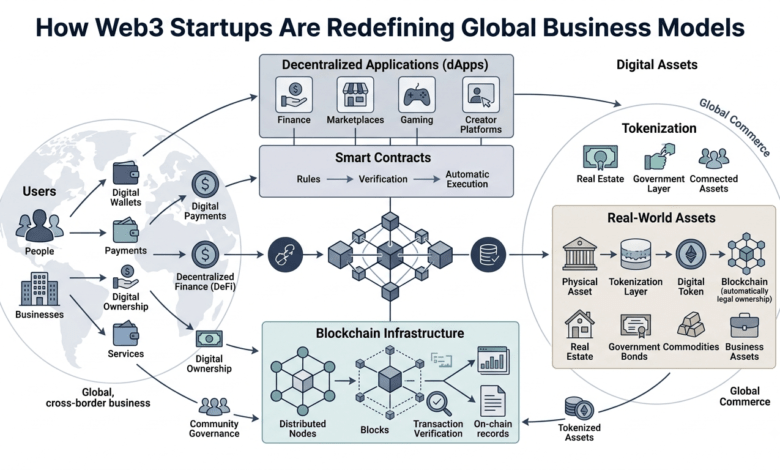
Web3 refers to a broad, evolving architectural framework for internet applications built on decentralized networks, cryptographically verified ownership, and programmatic execution layers. Rather than operating as a single, monolithic network, the Web3 economy encompasses a complex ecosystem of layer-1 blockchains, layer-2 rollups, decentralized storage protocols, and application-specific execution environments.
At its core, Web3 transitions digital interaction from a read-write paradigm (Web2) to a read-write-own model powered by several foundational technologies:
-
Blockchain Infrastructure: Distributed ledgers that preserve a shared state without relying on a central database administrator.
-
Smart Contracts: Self-executing code deployed to a blockchain that automates financial logic, asset settlement, and conditional access.
-
Tokens: Programmatic digital units representing value, access rights, governance power, or real-world asset claims.
-
Decentralized Applications (dApps): Software interfaces that interact directly with underlying smart contracts rather than siloed backend servers.
-
Wallet-Based Identity: Cryptographic key pairs that allow users to authenticate across multiple platforms without creating centralized platform accounts.
-
Community Governance: Mechanisms enabling token holders to participate in protocol parameter changes and treasury allocations.
Web3 is not a guaranteed replacement for Web2. Traditional centralized servers, centralized databases, and managed IT services remain drastically faster, cheaper, and more scalable for the vast majority of consumer internet tasks. Web3 serves as a specialized database and settlement layer best suited for applications requiring censorship resistance, global open access, cross-border interoperability, and automated trust minimization.
The Business Models Web3 Startups Are Building
Entrepreneurs building blockchain startups are moving past basic token sales to establish repeatable, specialized business architectures. Ten distinct blockchain business models have emerged across major economic sectors:
1. Token-Based Economies
Tokenized architectures replace traditional platform fees with internal cryptographic assets designed to capture and distribute network value. Utility tokens provide access to services, reward network participants, or serve as payment gas. However, token utility alone does not guarantee economic stability; without organic underlying demand for the service, token supply expansion leads directly to hyper-inflation and protocol failure.
2. Decentralized Finance (DeFi) Protocols
DeFi protocols replace traditional financial intermediaries—brokers, market makers, and clearinghouses—with automated liquidity pools and lending smart contracts. These protocols earn revenue by taking a micro-fraction of automated swap fees, loan interest margins, or liquidations. Unlike traditional fintechs, DeFi protocols operate with minimal overhead, continuous 24/7 global uptime, and automated risk management.
3. Creator-Owned Platforms
Web3 creator networks leverage non-fungible tokens (NFTs) and membership tokens to reconfigure digital creator monetization. Creators sell verifiable digital collectibles or access tokens directly to audiences, bypassing platform cuts taken by Web2 social media algorithms. Secondary-market royalty enforcement, while historically volatile, remains viable when embedded at the contract layer within closed marketplace ecosystems.
4. Tokenized Real-World Assets (RWAs)
Tokenization platforms bridge traditional financial assets—such as U.S. Treasury bills, corporate debt, private credit, and commercial real estate—onto public ledgers. These startups generate revenue through issuance fees, asset management fees, and technology licensing.
Legal Ownership vs. Token Representation: A token on a blockchain is merely an informational record. True legal ownership depends on enforceable legal custody agreements, special purpose vehicles (SPVs), and local property law. The token only grants real-world legal rights if the underlying legal issuer is contractually bound to recognize the token holder as the beneficiary.
5. Decentralized Physical Infrastructure Networks (DePIN)
DePIN startups use token incentives to crowd-source real-world physical infrastructure, including wireless cellular networks, distributed cloud storage, GPU compute clusters, and mapping hardware. Token emissions bootstrap early hardware deployments, subsidizing node operators until organic demand from enterprise buyers generates self-sustaining cash flow.
6. Blockchain-Based Payments
Payment-focused Web3 startups leverage fiat-backed stablecoins to facilitate global cross-border transfers, B2B invoice settlements, and instant merchant clearing. By using public blockchains as settlement networks, these companies bypass the delays, fee layers, and weekend cutoffs inherent to SWIFT and correspondent banking.
7. Community-Owned Businesses and DAOs
Decentralized Autonomous Organizations (DAOs) manage community treasuries and protocol parameters via on-chain token voting. While DAOs provide open governance and capital allocation transparency, token-weighted voting suffers from low participation, voter apathy, and exposure to governance capture by wealthy token holders (“whales”).
8. Web3 Gaming and Digital Economies
Web3 gaming startups tokenize in-game items, currencies, and land, allowing players to buy, sell, and trade assets across open secondary marketplaces. Successful contemporary Web3 games prioritize core gameplay mechanics over financial speculation, offering digital asset ownership as a secondary retention feature rather than a mandatory requirement.
9. Digital Identity and Portable Reputation
Identity startups deploy decentralized identifiers (DIDs) and zero-knowledge proofs (ZKPs) to create portable digital profiles. Users can prove credentials—such as accredited investor status, credit scores, or employment history—without revealing sensitive personal data or relying on centralized identity providers like Google or Facebook.
10. Decentralized Data and AI Infrastructure
The intersection of Web3 and artificial intelligence focuses on decentralized compute markets, data tokenization, and model provenance. Startups coordinate idle GPU power across global networks to train machine learning models, creating open compute marketplaces that offer cheaper rates than centralized cloud monopolies.
How Do Web3 Startups Actually Make Money?
Issuing a token is a capital-raising event or a network distribution mechanism—it is not a sustainable operational revenue model. Functional Web3 business models generate revenue through standard, cash-flow-driven monetization mechanisms:
                          ┌─────────────────────────┐
                          │   Web3 Startup Revenue  │
                          └────────────┬────────────┘
                                       │
         ┌─────────────────────────────┼─────────────────────────────┐
         ▼                             ▼                             ▼
┌───────────────────┐        ┌───────────────────┐        ┌───────────────────┐
│ Protocol & Swap   │        │ Enterprise SaaS   │        │ Asset Management  │
│ Fees              │        │ & API Subscriptions│       │ & Issuance Fees   │
└───────────────────┘        └───────────────────┘        └───────────────────┘
-
Protocol & Transaction Fees: Protocol smart contracts collect automated micro-fees on volume (e.g., decentralized exchange swap fees or borrowing spreads).
-
Enterprise SaaS & API Services: Provisioning dedicated node infrastructure, blockchain indexing APIs, and enterprise data feeds via traditional recurring subscription models.
-
Asset Management & Issuance Margins: Tokenization platforms charge structural setup fees, minting fees, and annual management fees on tokenized real-world assets.
-
Marketplace Commission Fees: Monetizing peer-to-peer asset transfers by taking a percentage fee on executed trades.
-
Custody & Staking Yield Services: Running institutional validator infrastructure or managing institutional wallet custody, earning commission on yield generation.
Real-World Web3 Startup Examples
The following confirmed, operating projects illustrate how blockchain startups generate revenue and execute modern Web3 business models:
-
Helium Mobile
-
Sector: DePIN (Decentralized Physical Infrastructure)
-
Business Model: Hybrid wireless carrier selling monthly consumer cellular plans and carrier offload data services.
-
Web3 Component: Token incentives distribute reward tokens to individuals deploying physical cellular hotspots.
-
Web2 Difference: Reduces capital expenditure for cell tower deployment by outsourcing hardware coverage to node hosts.
-
Current Status: Confirmed (Operating commercial network generating over $2.5 million in monthly revenue).
-
Why It Matters: Demonstrates that DePIN tokenomics can successfully build real-world, revenue-generating telecommunications coverage.
-
-
Ondo Finance
-
Sector: Tokenized Real-World Assets (RWA)
-
Business Model: Institutional asset management and tokenized asset issuance.
-
Web3 Component: Issues yield-bearing tokens (e.g., USDY) backed by short-term U.S. Treasuries on public blockchains.
-
Web2 Difference: Provides 24/7 liquid access to yield-bearing institutional instruments without traditional brokerage settlement delays.
-
Current Status: Confirmed (Holds over $3.7 billion in Total Value Locked across its asset suite).
-
Why It Matters: Proves institutional demand for on-chain, yield-bearing traditional assets.
-
-
Uniswap Labs
-
Sector: Decentralized Finance (DeFi)
-
Business Model: Protocol fee capture, interface swap fees, and enterprise developer tools.
-
Web3 Component: Deploys automated market maker (AMM) smart contracts on public blockchains.
-
Web2 Difference: Replaces centralized order books and clearinghouses with self-custodial liquidity pools.
-
Current Status: Confirmed (Flipped its protocol fee switch via DAO governance, burning native tokens via accrued fees).
-
Why It Matters: Establishes automated, programmatic cash-flow capture directly within decentralized exchange infrastructure.
-
Detailed Web3 Case Studies
Case Study 1: Helium Mobile (DePIN Wireless Coverage)
┌─────────────────┐       Token Emissions       ┌──────────────────┐
│ Helium Protocol ├────────────────────────────►│ Hotspot Hosts    │
└────────┬────────┘                             └────────┬─────────┘
         │                                               │
   Offload Fees                                  Physical Wireless
         │                                            Coverage
         ▼                                               ▼
┌─────────────────┐       Monthly Subscription  ┌──────────────────┐
│ Major Telecoms  ├────────────────────────────►│ Mobile Users     │
└─────────────────┘                             └──────────────────┘
-
Problem Being Solved: Traditional telecom operators face massive capital expenses deploying cell towers in dense urban environments, leading to high data costs and coverage dead zones.
-
Traditional Business Model: Telecoms spend billions acquiring real estate, buying spectrum, building towers, and passing those capital costs down to consumers through locked contracts.
-
Web3 Model: Individuals buy and install compact 5G and Wi-Fi hotspots in their homes and businesses. The network rewards hosts with tokens based on coverage provided and data offloaded.
-
Revenue Mechanism: Helium Mobile sells traditional consumer cellular plans for cash and charges major national mobile operators data offload fees to route overflow traffic through Helium hotspots.
-
Customer Incentive: Consumers get cheap mobile plans; hotspot hosts earn passive revenue; major carriers save on infrastructure expansion.
-
Technology Involved: Solana blockchain for low-cost token distribution, custom Wi-Fi/5G hotspot hardware, and mobile SIM integration.
-
Evidence of Adoption: Recorded $2.5 million in monthly revenue, over 700,000 subscriber sign-ups, and 111 terabytes of daily offloaded data.
-
Main Challenge: Managing long-term token emission economics when hardware deployment slows down and maintaining reliable service quality across non-professional hardware hosts.
Case Study 2: Ondo Finance (Tokenized Institutional Treasury Management)
-
Problem Being Solved: On-chain capital (such as stablecoins held by Web3 corporate treasuries and DeFi funds) historically earned zero interest or had to take high smart-contract risks in crypto lending pools.
-
Traditional Business Model: Investment banks and fund managers sell money market funds with high minimum investment thresholds, operating strictly during bank wire hours.
-
Web3 Model: Ondo issues permissioned and permissionless yield-bearing tokens representing direct beneficial ownership in short-term U.S. Treasuries and high-grade bank deposits.
-
Revenue Mechanism: Ondo collects an annual asset management fee (basis points) on total assets managed within its funds.
-
Customer Incentive: Web3 corporate treasuries receive institutional risk-adjusted yields paid directly to their wallets with 24/7 liquidity.
-
Technology Involved: Smart contracts deployed across Ethereum, Solana, and layer-2 networks integrated with institutional custody banks and transfer agents.
-
Evidence of Adoption: Surpassed $3.7 billion in Total Value Locked (TVL) across its tokenized asset offerings.
-
Main Challenge: Navigating complex international securities compliance laws and maintaining strict 1:1 liquid reserve backing across global jurisdictions.
Where Web3 Has a Genuine Business Advantage
Web3 technology provides clear structural advantages over traditional software in specific business scenarios:
-
Global Access & Borderless Settlement: Public blockchains do not recognize geographic borders. A business can send digital value to any compatible wallet address worldwide without requesting permission from intermediary banks.
-
Programmatic Financial Automation: Smart contracts execute transactions automatically when predefined code conditions are met, eliminating manual escrow agents, delayed invoice processing, and billing reconciliation teams.
-
Verifiable Digital Ownership: Users maintain true self-custodial ownership of digital assets, preventing platforms from unilaterally confiscating or modifying user property.
-
Systemic Interoperability: Open token standards (e.g., ERC-20, ERC-721) allow independent developers to build services on top of existing platforms without requiring complex, custom B2B API integrations.
-
Auditability & Transparent Accounting: All public ledger transfers are immutably recorded, allowing real-time, automated financial auditing for corporate treasuries and compliance teams.
Where Web3 Business Models Still Struggle
Despite technical advancements, Web3 adoption faces severe practical limitations:
-
Complex User Experience: Managing seed phrases, paying variable gas fees, and navigating wallet approvals present major barriers to everyday mainstream consumers.
-
Irreversibility & Security Risks: Blockchain transactions cannot be reversed. Exploits, smart-contract bugs, phishing scams, and lost private keys result in permanent capital loss without central customer support recovery options.
-
Regulatory Uncertainty: Shifting global regulatory frameworks make token issuance, decentralized governance, and cross-border compliance difficult to navigate.
-
Scalability & Latency: High-throughput blockchains still lag behind the execution speed and low latency of centralized database architectures like AWS or Visa.
-
Token Volatility & Speculation: Speculative token price movements frequently obscure the actual underlying performance and health of the business.
Why Tokenomics Can Make or Break a Web3 Startup
Tokenomics refers to the economic structure, supply dynamics, distribution mechanics, and incentive design of a token within a Web3 ecosystem. Poorly designed tokenomics is the primary cause of protocol failure.
                  ┌──────────────────────────────────────────┐
                  │          Balanced Token Model            │
                  └────────────────────┬─────────────────────┘
                                       │
         ┌─────────────────────────────┴─────────────────────────────┐
         ▼                                                           ▼
┌─────────────────────────────────┐                         ┌─────────────────────────────────┐
│       Supply Controls           │                         │       Organic Demand Drivers    │
├─────────────────────────────────┤                         ├─────────────────────────────────┤
│ • Structured Vesting Schedules  │                         │ • Real Service Access Utility   │
│ • Clear Max Supply Caps         │                         │ • Fee Buyback & Burn Mechanisms │
│ • Algorithmic Emissions Control │                         │ • Governance Rights over Value  │
└─────────────────────────────────┘                         └─────────────────────────────────┘
Key Elements of Sound Tokenomics
-
Supply Dynamics: Clear maximum supply caps, inflation schedules, and predictable emission rates.
-
Vesting Schedules: Multi-year lockup periods for founders, team members, and early investors to prevent early token dumps.
-
Utility & Value Capture: Direct linkage between protocol usage and token demand (e.g., fee buyback-and-burn mechanics or staking rewards).
-
Distribution Transparency: Broad initial distribution to prevent extreme token concentration among a few insiders.
Crucial Insight: A rising token price does not mean a Web3 startup has achieved product-market fit. Token appreciation is often driven by market speculation; sustainable business health is measured strictly by protocol fees, paid user acquisition, recurring revenue, and active retention.
Regulation and the Future of Web3 Businesses
Regulatory enforcement has moved from theoretical guidelines into enforced legal frameworks across major global markets:
-
United States: The enactment of the GENIUS Act (Guiding and Establishing National Innovation for U.S. Stablecoins Act) established a clear federal framework for payment stablecoin issuers. The law mandates 1:1 liquid reserve backing (cash and short-term Treasuries), prohibits paying yield on base stablecoins, and sets strict OCC/Federal Reserve oversight. Concurrently, SEC enforcement continues to evaluate whether specific token distribution models meet the criteria of securities transactions.
-
European Union: The Markets in Crypto-Assets (MiCA) regulation is fully active, establishing mandatory licensing for Crypto-Asset Service Providers (CASPs), strict capital reserve rules for stablecoin issuers, and standardized consumer disclosure requirements across all 27 EU member states.
-
United Kingdom, Singapore, & Hong Kong: These jurisdictions have implemented mandatory licensing regimes for digital asset exchanges, stablecoin issuers, and custodial service providers, focusing on asset segregation, anti-money laundering (AML), and investor protection.
Traditional Businesses vs Web3 Startups
Web3 technology will not completely replace traditional business models. The future market landscape points toward widespread integration of hybrid models that combine traditional business practices with decentralized infrastructure.
┌─────────────────────────────────────────────────────────────────────────┐
│                          HYBRID BUSINESS MODEL                          │
├───────────────────────────────┬─────────────────────────────────────────┤
│    TRADITIONAL CAPABILITIES   │           WEB3 INFRASTRUCTURE           │
├───────────────────────────────┼─────────────────────────────────────────┤
│ • Regulated Fiat On/Off Ramps │ • Blockchain Settlement Rails           │
│ • Dedicated Customer Support  │ • Tokenized Asset Ownership             │
│ • Fraud Dispute Mediation     │ • Smart Contract Payment Automation     │
│ • Corporate Legal Accountability│ • Automated Liquidity Pools           │
└───────────────────────────────┴─────────────────────────────────────────┘
Web2 tech giants excel at high-speed data processing, complex user interface design, and personalized consumer services. Web3 infrastructure excels at international monetary settlement, open asset issuance, and verifiable digital ownership. Most mainstream business operations will maintain centralized corporate management while utilizing Web3 settlement backends where they provide cost and speed savings.
How Web3 Could Change Global Commerce
The integration of Web3 infrastructure is restructuring several core components of global trade:
-
Cross-Border B2B Settlement: Companies clear international invoices in minutes using regulated stablecoins, eliminating multi-day bank hold times and reducing foreign exchange markup costs.
-
Global Freelance Compensation: International contractors receive instant, micro-fractional payments directly to self-custodial wallets without losing funds to cross-border transfer fees.
-
Supply Chain Provenance: Enterprise blockchains track physical goods—such as pharmaceuticals, luxury items, and agricultural products—from raw material origin to final delivery, verifying authenticity and compliance.
-
Democratization of Capital Markets: Asset tokenization allows retail investors around the world to access fractionated ownership of real-world assets that were previously limited to institutional investors.
Web3 in Emerging Markets
The commercial impact of Web3 adoption is significantly higher in developing nations than in mature economies:
-
Protection Against Local Currency Inflation: In economies suffering from hyper-inflation, dollar-backed stablecoins provide individuals and small businesses with a digital store of value.
-
Low-Cost Remittance Corridors: Cross-border workers send funds back to families using low-cost blockchain networks, bypassing traditional remittance fees.
-
Smartphone-Native Financial Access: Individuals who lack traditional bank accounts due to strict institutional documentation requirements can access basic financial services using a low-cost smartphone and a Web3 digital wallet.
Note: While Web3 provides financial access, local fiat cash-out points (“off-ramps”) still present fee bottlenecks that depend on local financial infrastructure.
Web3 and AI: A New Business Stack?
The convergence of artificial intelligence and Web3 technologies is creating a novel technological stack across three primary areas:
-
Autonomous AI Agent Payments: Autonomous AI agents cannot open traditional bank accounts. Using Web3 wallets, AI agents can make micro-payments to other software services, rent compute resources, and purchase data APIs automatically using stablecoins or cryptocurrencies.
-
Decentralized Compute & Storage for AI: DePIN networks aggregate global GPU capacity, lowering the cost of training machine learning models compared to centralized cloud monopolies.
-
Data Provenance and Deepfake Verification: Public ledgers provide cryptographic timestamping and digital signatures to verify the origin and authenticity of digital media, combating AI-generated misinformation.
What Web3 Business Models Could Look Like by 2030
Three potential structural scenarios outline the trajectory of Web3 business adoption over the next decade:
-
Conservative Scenario (Niche Financial Infrastructure): Web3 technology remains primarily restricted to institutional cross-border settlement, crypto-native asset trading, and specialized high-cost financial transactions due to persistent regulatory friction.
-
Mainstream Scenario (Invisible Infrastructure Backend): Public blockchains become the silent, underlying infrastructure for global payments, reward loyalty programs, and asset settlement. Consumers interact with Web3 applications seamlessly without needing to manage private keys or gas fees directly.
-
Accelerated Scenario (Open Autonomous Economy): Tokenized assets, decentralized infrastructure networks (DePIN), autonomous AI agents, and DAO governance capture major global market share, significantly replacing legacy corporate structures with open, automated protocol economies.
Five Questions Every Web3 Founder Should Answer
-
What specific business problem requires a decentralized blockchain layer instead of a traditional centralized database?
-
Why does your business model require a native token, and what organic demand mechanisms drive the token’s long-term value?
-
How does the company generate cash-flow revenue independent of initial token sales or market speculation?
-
What clear value proposition does the platform provide to everyday mainstream users who do not care about Web3 technology?
-
What specific regulatory and legal obligations apply to your token issuance, asset custody, and cross-border operations?
FAQ
What are Web3 startups?
Web3 startups are companies and developer teams that build business applications using blockchain infrastructure, smart contracts, digital tokens, and decentralized networks to facilitate payments, asset ownership, and peer-to-peer commerce.
How do Web3 startups make money?
Web3 startups generate revenue through transaction fees, smart contract execution fees, enterprise SaaS subscriptions, API licensing, asset management fees, and marketplace commissions. Issuing a token is a capital-raising event or network incentive tool, not an operational revenue stream.
How are Web3 startups different from Web2 companies?
Web2 companies rely on centralized servers, proprietary databases, and corporate-controlled user data. Web3 startups use distributed ledgers, smart contracts, and wallet-based identities that allow users to maintain direct cryptographic ownership of their assets and data.
What business models are emerging in Web3?
Emerging models include Decentralized Physical Infrastructure Networks (DePIN), Tokenized Real-World Assets (RWAs), Decentralized Finance (DeFi) protocols, creator-owned token networks, and wallet-based identity solutions.
Are Web3 startups actually profitable?
Profitability varies across the industry. Infrastructure providers, stablecoin issuers, tokenization platforms, and top-tier DeFi protocols generate millions of dollars in monthly protocol revenue, while speculative, token-only projects frequently fail to achieve sustainable cash flow.
What industries are adopting Web3?
Major adoption is occurring in cross-border payments, corporate treasury management, asset management, telecommunications, trade finance, gaming, and artificial intelligence compute infrastructure.
What are the biggest risks for Web3 startups?
Key risks include shifting international regulations, smart-contract code exploits, token price volatility, complex end-user experiences, irreversible transactions, and legal ownership challenges regarding tokenized real-world assets.
Will Web3 replace traditional businesses?
No. Web3 technology will not completely replace traditional businesses. Most mainstream applications will adopt hybrid business models, combining centralized customer support and user interfaces with blockchain backends for settlement and asset issuance.
Web3 startups are redefining digital business models not by eliminating corporate finance, but by introducing programmatic automation, global asset interoperability, and continuous financial settlement. As the industry matures beyond early speculative cycles, the startups that succeed will be those that solve clear, real-world operational problems—using blockchain technology where it provides a genuine structural advantage, while delivering the reliability, security, and convenience that global commerce demands.