

Web3 Marketing Strategy Comparison Table
| Strategy | Best For | Main Benefit | Main Risk | Implementation Difficulty |
| Product-First Onboarding | All Web3 projects | Organic user retention; minimizes churn driven by speculation | High technical effort required before launching marketing campaigns | High (Requires tight product-marketing alignment) |
| Developer Documentation & Hackathons | Infrastructure, L1/L2s, DeFi protocols | Builds sticky, long-term ecosystem utility and continuous integration | High competition for developer mindshare across ecosystems | High (Requires dedicated technical relations teams) |
| Targeted Onchain Airdrops | DeFi & Governance Protocols | Rapid initial liquidity and network bootstrapping | Sybil farming, mercenary capital, and immediate post-claim token dumps | Medium (Requires complex anti-Sybil screening) |
| Educational & Public Build Content | Consumer Web3, Wallets, Identity | Establishes domain authority and long-term user trust | Slow initial growth; requires consistent publishing cycles | Low (Accessible to early-stage startups) |
| Creator & Key Opinion Leader (KOL) Partnerships | Web3 Gaming, Creator Economy | Reaches established, adjacent Web2 and Web3 communities | Disclosure non-compliance, reputational risk from mercenary promoters | Medium (Requires strict due diligence and contract rules) |
| Localized Regional Communities | Global Payment & Remittance Protocols | Captures non-English speaking emerging markets with real usage | Operational complexity in managing decentralized regional teams | Medium (Requires localized community management) |
| Community-Led Governance & DAOs | Decentralized Protocols, Public Goods | Deepens user advocacy and decentralizes project ownership | Voter apathy, governance capture by large holders (whales), operational friction | High (Requires mature governance frameworks) |
The era of hyper-speculative Web3 promotion has come to an end. The marketing playbooks that dominated earlier cycles—characterized by artificial Telegram member counts, bought X (formerly Twitter) followers, mercenary airdrop campaigns, and continuous token price hype—no longer build viable Web3 companies.
Building sustainable Web3 community growth requires shifting from vanity metrics to real, measurable adoption. Contemporary Web3 marketing strategies prioritize product utility, long-term user retention, developer activity, and bot-resistant engagement layers. This guide outlines how Web3 projects attract and retain real users, developers, creators, and enterprise partners while navigating the regulatory and technical realities of modern digital ecosystems.
What Does “Real Web3 Community Growth” Mean?
In Web3, audience scale is frequently confused with community strength. A project boasting 100,000 Telegram members may have fewer than 50 real active users if the channel is dominated by automated bots and mercenary speculative accounts.
Vanity Metrics vs. Meaningful Metrics
               ┌─────────────────────────────────────────┐
               │    Web3 Community Evaluation Layers     │
               └────────────────────┬────────────────────┘
                                    │
         ┌──────────────────────────┴──────────────────────────┐
         ▼                                                     ▼
┌───────────────────────────────┐             ┌───────────────────────────────┐
│        Vanity Metrics         │             │      Meaningful Metrics       │
├───────────────────────────────┤             ├───────────────────────────────┤
│ • Raw Social Followers        │             │ • Daily Active Users (DAU)    │
│ • Discord / Telegram Members  │             │ • 30-Day Cohort Retention     │
│ • Superficial Post Impression │             │ • Active Developer Repos      │
│ • Total Token Holder Count    │             │ • Weekly Onchain Transactions │
└───────────────────────────────┘             └───────────────────────────────┘
-
Vanity Metrics: Raw social follower counts, total Discord/Telegram members, post impressions, and total wallet holder numbers (which can be easily inflated by automated script-generated wallets).
-
Meaningful Metrics: Daily and monthly active users (DAU/MAU), 30-day cohort retention rates, active developer pull requests, recurring protocol revenue, governance proposal participation, and unique active addresses interacting with smart contracts over time.
Real community growth occurs when users interact with a product because it solves a specific problem, not simply because they anticipate an upcoming token distribution.
Web3 Marketing Strategies That Actually Build Community Growth
The following fifteen strategies reflect proven, emerging, and experimental tactics designed to create long-term ecosystem retention:
1. Build the Product Before the Hype (Proven Strategy)
Marketing cannot permanently compensate for an unusable product. Projects that launch aggressive marketing campaigns before establishing a core value proposition suffer from high churn. Establishing product-market fit—supported by clear user interfaces, low gas overhead, and explicit problem-solving capabilities—creates the foundation for organic word-of-mouth referral.
2. Community-Led Content Creation (Proven Strategy)
Empowering active users to create tutorials, technical documentation, and ecosystem breakdowns builds authentic trust. User-generated content (UGC) outperforms corporate brand messaging because prospective users seek objective verification from peers actively using the protocol.
3. Structured Platform Spaces (Proven Strategy)
Selecting community platforms must align with target user personas rather than default industry trends:
-
Discord: Ideal for technical support, structured developer working groups, and modular role-based channels.
-
Farcaster: Highly effective for reaching crypto-native developers, founders, and Web3 venture investors.
-
X (formerly Twitter): Essential for broad top-of-funnel announcements, ecosystem news, and brand visibility.
-
Project-Owned Forums (Discourse): Best for long-form governance proposals, protocol architecture discussions, and formal feedback.
4. Educational Content Marketing (Proven Strategy)
Web3 applications introduce friction, including private key management, network switching, and smart contract approvals. Educational marketing—focused on step-by-step onboarding guides, security best practices, and video walkthroughs—reduces drop-off rates at the top of the funnel.
5. Transparent Creator & KOL Partnerships (Proven Strategy)
Working with creators requires evaluating audience engagement quality over follower counts. Successful Web3 projects establish long-term advisory or content partnerships with respected domain experts rather than buying one-off promotional posts from mercenary influencers.
Regulatory Compliance: Promotional partnerships involving financial products or native tokens must comply with local advertising standards (such as U.S. FTC disclosure guidelines or European ESMA rules), explicitly labeling paid content to preserve user trust and avoid regulatory penalties.
6. Non-Speculative Community Incentives (Emerging Strategy)
Transitioning from pure financial rewards to non-speculative incentives—such as soulbound contributor badges, Discord role progression, exclusive developer access, and platform feature priority—drives engagement without attracting mercenary liquidity providers who exit once financial subsidies end.
7. Targeted Onchain Airdrops (Emerging Strategy)
See dedicated analysis section below.
8. Structured Ambassador Programs (Proven Strategy)
Ambassador programs succeed when given explicit operational KPIs, such as organizing regional developer meetups, translating documentation into local languages, or moderating community support queues. Rewarding regional leaders with structured grants or recurring stipends creates dedicated operational nodes globally.
9. Build in Public (Proven Strategy)
Publishing public code repositories, transparent engineering updates, quarterly financial reports, and candid post-mortems after technical incidents builds institutional trust. Open communication signals long-term alignment and founder accountability.
10. Dedicated Developer Relations (DevRel) (Proven Strategy)
For L1/L2 blockchains, middleware, and infrastructure protocols, developers are the core customer base. Successful developer marketing relies on comprehensive SDK documentation, responsive technical support channels, hackathons with real deployment tracks, and ecosystem developer grants.
11. Strategic Ecosystem Partnerships (Proven Strategy)
Integrations with widely used wallets, payment gateways, and complementary protocols drive immediate distribution. Partnering with established ecosystem platforms allows new projects to tap into pre-existing, verified user bases.
12. High-Touch Community Events (Proven Strategy)
Interactive technical workshops, core developer AMAs, regional hackathons, and localized community meetups forge stronger relationships than passive digital broadcasts. Direct interactions turn passive users into active community advocates.
13. Comprehensive Localization (Emerging Strategy)
Web3 adoption varies across regions. Translating product interfaces, documentation, and support channels into non-English languages—while appointing regional community managers in key markets across Latin America, Southeast Asia, and Eastern Europe—unlocks significant growth corridors.
14. Verifiable Social Proof (Proven Strategy)
Highlighting real user case studies, verified corporate partners, independent code audits, and transparent onchain analytics builds credibility without resorting to manufactured urgency or misleading promotional claims.
15. Retention-Focused Onboarding (Proven Strategy)
Acquisition without retention is wasted capital. Implementing automated email/push notifications for protocol events, personalized onboarding flows, and continuous product improvements ensures newly acquired users remain active over multi-month horizons.
Are Airdrops Still Effective for Community Growth?
Airdrops—the free distribution of native tokens to early users—were historically treated as a guaranteed user acquisition mechanism. However, their efficacy has declined due to widespread exploitation by automated Sybil networks (entities operating thousands of automated wallets to extract token allocations).
                      ┌───────────────────────────────┐
                      │    Airdrop Dynamic Tracing    │
                      └───────────────┬───────────────┘
                                      │
         ┌────────────────────────────┴────────────────────────────┐
         ▼                                                         ▼
┌─────────────────────────────────┐                       ┌─────────────────────────────────┐
│     Targeted Utility Model      │                       │     Mercenary Speculation       │
├─────────────────────────────────┤                       ├─────────────────────────────────┤
│ • Retains active developers     │                       │ • Sybil bots dilute real users  │
│ • Rewards multi-month usage     │                       │ • 80%+ sell token on day 1      │
│ • Boosts governance participation│                       │ • Metrics collapse post-launch  │
└─────────────────────────────────┘                       └─────────────────────────────────┘
Potential Benefits
-
Initial Bootstrapping: Provides initial liquidity and distributes protocol governance power among early adopters.
-
High Initial Visibility: Generates immediate industry attention and top-of-funnel discovery.
Potential Drawbacks & Risks
-
Mercenary Capital: Users acquired purely via airdrop expectations frequently dump tokens immediately upon receipt and abandon the protocol.
-
Community Fragmentation: Distributing tokens unevenly or failing to filter out Sybil bots alienates genuine long-term contributors.
-
Regulatory Exposure: Unregistered token distributions may trigger securities scrutiny across strict regulatory jurisdictions.
Airdrops are not a primary marketing strategy; they are an economic distribution mechanism that only succeeds when applied to a user base that already values the underlying product.
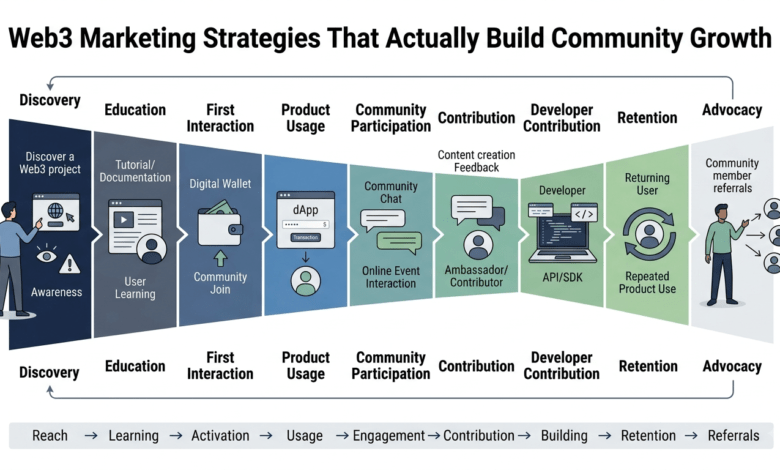
The Web3 Community Growth Funnel
Converting a casual observer into a core protocol contributor requires a structured, multi-stage funnel:
┌─────────────────────────────────────────────────────────────────────────┐
│ 1. AWARENESS: X/Twitter Threads, Educational Content, Podcasts, PR     │
├─────────────────────────────────────────────────────────────────────────┤
│ 2. EDUCATION: Documentation, Interactive Tutorials, Onboarding Guides   │
├─────────────────────────────────────────────────────────────────────────┤
│ 3. FIRST INTERACTION: Wallet Connection, Testnet Tryouts, Low-Fee Swap  │
├─────────────────────────────────────────────────────────────────────────┤
│ 4. PRODUCT USAGE: Regular Protocol Activity, Core Feature Adoption      │
├─────────────────────────────────────────────────────────────────────────┤
│ 5. CONTRIBUTION: Forum Governance, Bug Reporting, Discord Support       │
├─────────────────────────────────────────────────────────────────────────┤
│ 6. RETENTION & ADVOCACY: Ambassador Roles, Ecosystem Grants, UGC        │
└─────────────────────────────────────────────────────────────────────────┘
-
Awareness: Reaching new audiences via technical blog posts, educational social threads, podcast appearances, and ecosystem announcements.
-
Education: Directing interested users to clear, high-quality documentation, onboarding portals, and simple walkthroughs that explain how the product works.
-
First Interaction: Guiding the user through their first low-friction transaction, such as connecting a wallet, minting a free testnet badge, or completing an initial swap.
-
Product Usage: Converting single transactions into recurring habits by providing consistent platform utility and responsive customer support.
-
Contribution: Encouraging experienced users to answer support questions, author documentation edits, or participate in governance discussions.
-
Retention & Advocacy: Rewarding top contributors with official ambassador status, community grant funding, or elevated governance roles, turning them into long-term brand advocates.
Which Platforms Should Web3 Projects Use?
No single platform serves every community need. A multi-platform strategy matches specific content formats to target audiences:
| Platform | Best Audience | Best Content Format | Main Weakness / Limitation |
| X (formerly Twitter) | Broad crypto community, retail investors, industry media | Short announcements, educational threads, X Spaces | High noise-to-signal ratio; vulnerable to bot spam in replies |
| Discord | Developers, power users, dedicated community members | Moderated chat channels, support tickets, working groups | Complex onboarding structure for non-crypto-native consumers |
| Farcaster | Crypto-native builders, Web3 VCs, technical founders | Short-form posts (“casts”), integrated mini-apps (“frames”) | Smaller overall audience scale compared to mainstream Web2 networks |
| Telegram | Regional user groups, quick support desks, announcements | Linear chat streams, broadcast channels | Vulnerable to impersonation scams, phishing, and spam bots |
| YouTube / TikTok | Mainstream retail users, visual learners | Video tutorials, visual walkthroughs, founder interviews | High content production effort required for continuous output |
| Discourse Forums | Token holders, core contributors, DAO delegate networks | Long-form governance proposals, technical RFCs | Low day-to-day engagement velocity; formal documentation style |
How to Measure Real Web3 Community Growth
Tracking community health requires monitoring operational and onchain metrics across five distinct categories:
                          ┌─────────────────────────┐
                          │ Web3 Measurement Stack  │
                          └────────────┬────────────┘
                                       │
         ┌─────────────────────────────┼─────────────────────────────┐
         ▼                             ▼                             ▼
┌───────────────────┐        ┌───────────────────┐        ┌───────────────────┐
│ Active Usage      │        │ Retention Metrics │        │ Onchain Metrics   │
├───────────────────┤        ├───────────────────┤        ├───────────────────┤
│ • DAU / MAU Ratio │        │ • 30/90-Day Cohort│        │ • Smart Contract  │
│ • Active Wallets  │        │ • Recurrent Swaps │        │   Interactions    │
└───────────────────┘        └───────────────────┘        └───────────────────┘
-
Acquisition: Cost per Qualified User (CPQU), organic vs. paid referral ratios, and initial wallet connection conversion rates.
-
Activation: Percentage of connected wallets that execute a meaningful secondary transaction within 48 hours of onboarding.
-
Retention: 30-day, 60-day, and 90-day wallet retention cohorts evaluating repeat usage.
-
Engagement: Percentage of active Discord members asking technical questions, participating in community calls, or submitting governance votes.
-
Onchain Activity: Smart contract call volume, total transaction count per active address, and protocol fee generation.
Onchain Metric Warning: Onchain analytics can be distorted by wash trading, automated bot activity, and individual users operating multiple wallet addresses. Always cross-reference onchain volume with offchain user retention metrics.
How to Avoid Fake Community Growth
Building a real community requires filtering out automated accounts and Sybil operators:
-
Deploy Contribution-Based Gateways: Require users to verify real-world activity—such as holding verified credentials, passing zero-knowledge proof checks, or achieving GitHub code contributions—before granting community privileges.
-
Implement Onchain Behavioral Scoring: Use reputation frameworks to score wallets based on account age, transaction history, and cross-chain activity, filtering out newly generated burner wallets.
-
Focus Incentives on Post-Selection Retention: Structure rewards to unlock over multi-month vesting schedules tied to ongoing platform usage rather than lump-sum instant payouts.
-
Enforce Manual Support & Moderation: Use human moderators alongside automated spam filters to eliminate phishing links and bot-generated responses in chat groups.
Should Every Web3 Community Have a Token?
No. Launching a token prematurely creates financial speculation before a startup establishes product utility.
When a Token Makes Sense
-
The protocol requires decentralized validator or node hardware coordination (e.g., DePIN infrastructure).
-
Governance over a massive public treasury or system parameters must be distributed among global participants.
-
The token functions as an essential, non-speculative unit of account within an automated smart contract system.
When a Token Is Unnecessary
-
The project operates as a traditional Web3 SaaS tool, analytics dashboard, or central API service.
-
The startup has not established product-market fit or baseline user retention.
-
The sole purpose of the token is to raise early capital without providing actual protocol utility.
How DAOs Can Turn Users Into Contributors
Decentralized Autonomous Organizations (DAOs) transition passive users into active co-owners when structured effectively:
-
Modular Working Groups: Break large communities into specialized operational teams (e.g., engineering, marketing, grants) with clear leadership and dedicated budgets.
-
Delegated Governance: Allow passive token holders to delegate their voting power to active, vetted community leaders to combat voter apathy.
-
Transparent Treasury Grants: Allocate protocol treasury funds to external developers and community builders through open, milestone-based grant proposals.
Common DAO Governance Pitfalls
-
Whale Dominance: Large capital holders controlling proposal outcomes, discouraging smaller token holders from voting.
-
Voter Fatigue: Bombarding community members with low-priority governance votes, leading to declining participation over time.
Web3 Community Growth Examples
The following confirmed, operating projects illustrate effective crypto community growth strategies across major Web3 sectors:
-
Base (Layer-2 Blockchain)
-
Sector: Layer-2 Infrastructure
-
Community Strategy: Developer-centric hackathons, continuous builder grants, and “Onchain Summer” creator campaigns.
-
Why It Worked: Focused entirely on developer onboarding and sub-cent transaction execution rather than launching a speculative network token.
-
Evidence of Adoption: Captured over 40% of overall Ethereum L2 TVL and led L2 weekly revenue generation.
-
Main Lesson: Infrastructure growth is driven by builder utility, not token hype.
-
-
Helium Mobile (DePIN Wireless)
-
Sector: Decentralized Physical Infrastructure
-
Community Strategy: Real-world subscriber referral programs combined with token rewards for hardware hotspot hosts.
-
Why It Worked: Aligned physical utility (cheap cell service) with host compensation for deploying coverage hardware.
-
Evidence of Adoption: Surpassed 700,000 sign-ups and generated over $2.5 million in monthly network revenue.
-
Main Lesson: Real-world hardware incentives drive long-term non-crypto consumer acquisition.
-
-
Farcaster (Decentralized Social)
-
Sector: Social Protocol
-
Community Strategy: Developer-first protocol architecture allowing builders to launch mini-apps (“Frames”) directly inside user feeds.
-
Why It Worked: Attracted high-quality Web3 builders who created custom social applications, driving organic developer retention.
-
Evidence of Adoption: Grew to over 1 million registered IDs and sustained high developer activity across third-party client applications.
-
Main Lesson: Programmable social protocols succeed by encouraging third-party developer innovation.
-
Detailed Web3 Case Studies
Deep Case Study 1: Base Network (Developer-First Infrastructure Growth)
-
Initial Audience: Ethereum developers, DeFi builders, and Web2 brands transitioning onchain.
-
Growth Strategy: Base executed a developer-first growth campaign centered on low transaction fees, open-source documentation, and the “Onchain Summer” initiative.
-
Community Structure: Decentralized builder channels on Discord, hackathons, and direct integrations with major developer toolings.
-
Incentives: Builder grants, retroactive gas credits, and ecosystem exposure rather than native token emissions.
-
Product Connection: Seamless integration with existing Coinbase wallet infrastructure and sub-cent L2 gas fees.
-
Retention: Developers remained because Base sustained high user throughput and low latency.
-
Key Lesson: Infrastructure platforms build sticky communities by providing superior developer tooling and distribution rather than speculative financial assets.
Deep Case Study 2: Helium Mobile (Physical Infrastructure Crowdsourcing)
-
Initial Audience: Tech enthusiasts, telecommunications deployers, and budget-conscious mobile consumers.
-
Growth Strategy: Combined traditional consumer mobile marketing ($20/month phone plans) with Web3 token rewards for hotspot operators.
-
Community Structure: Local venue host networks, mapping contributors, and hardware operator forums.
-
Incentives: HNT token emissions paid to hotspot hosts based on verified data coverage and carrier offload traffic.
-
Product Connection: Non-crypto consumers use standard cellular coverage without needing to interact with blockchain mechanics directly.
-
Retention: High subscriber retention driven by real-world cellular utility and low pricing.
-
Key Lesson: Abstracting Web3 complexity away from end consumers while retaining onchain incentives for infrastructure providers enables mass market scaling.
Web3 Marketing Tactics That Often Fail
Certain legacy growth tactics consistently destroy long-term brand equity:
-
Buying Followers and Engagement: Purchasing fake social followers or paying engagement farms creates artificial metrics that alienate institutional partners and obscure real user data.
-
Constant Token Price Promotion: Focus-shifting from product updates to token charts turns a community into a speculative trading group that exits immediately during market pullbacks.
-
Overusing “WAGMI” and Generic Hype: Relying on outdated Web3 slang instead of professional communication signals a lack of business maturity.
-
Unfiltered Giveaways: Running generic cash or token giveaways attracts bot networks and freebie seekers while failing to convert target users.
Marketing Web3 Products Without Losing Trust
Navigating Web3 marketing requires adhering to global regulatory guidelines and consumer protection standards:
-
Advertising Disclosures: Explicitly disclose paid influencer sponsorships, token allocations, and advisory roles in compliance with local regulatory guidelines (e.g., U.S. FTC, UK FCA, EU MiCA rules).
-
Avoid Promising Financial Returns: Never market utility tokens, staking yields, or governance tokens as passive investment opportunities or guaranteed sources of income.
-
Clear Risk Disclosures: Clearly state smart contract risks, wallet security responsibilities, and asset volatility warnings across all consumer-facing onboarding materials.
How Web3 Projects Can Build Global Communities
Operating a borderless protocol requires an intentional global marketing strategy:
-
Empower Regional Ambassadors: Hire local community managers to lead region-specific channels in native languages, tailored to regional cultural contexts.
-
Provide 24/7 Time-Zone Coverage: Structure community moderation queues across global shifts so users receive immediate technical support regardless of geographic location.
-
Host Regional Hackathons & Meetups: Allocate marketing funds to support local, developer-led events in key Web3 growth regions across Asia, Latin America, and Europe.
How AI Can Improve Web3 Community Management
Artificial intelligence tools enhance community operations when deployed responsibly:
-
Automated FAQ & Support Bots: AI agents trained on project documentation can resolve standard user onboarding queries 24/7, freeing human team members for complex troubleshooting.
-
Community Sentiment Analysis: Natural Language Processing (NLP) tools analyze Discord and forum chats in real time, alerting community managers to emerging user frustrations or technical bug reports.
-
Anti-Spam & Bot Detection: AI algorithms identify and automatically flag phishing links, automated bot accounts, and promotional spam across public chat channels.
Note: AI tools should assist human community managers—fully automated, AI-driven community responses feel disingenuous and alienate real users.
What Web3 Community Marketing Could Look Like by 2030
The long-term evolution of Web3 marketing will likely follow one of three potential scenarios:
-
Conservative Scenario (Web2 Convergence): Web3 marketing adopts standard Web2 digital marketing practices, retaining blockchain mechanics strictly for backend loyalty rewards and user identity management.
-
Mainstream Scenario (Embedded Onchain Identity): Portable digital identity (DIDs) and zero-knowledge proofs allow brands to target users based on verified onchain behavior without collecting invasive personal data.
-
Advanced Scenario (Autonomous AI-Agent Economies): AI agents operate wallets and execute transactions independently, requiring marketers to optimize campaigns for both human consumers and autonomous software agents.
A 90-Day Web3 Community Growth Plan
Days 1–30: Foundation & Infrastructure
-
Complete technical documentation, user onboarding guides, and support desk portals.
-
Set up core community channels (Discord/Farcaster) with role verification and anti-spam bots.
-
Establish baseline community tracking metrics (DAU, cohort retention, onchain activity).
Days 31–60: Targeted Onboarding & Developer Activation
-
Launch educational content campaigns, video tutorials, and technical blog posts.
-
Initiate strategic integration announcements with complementary ecosystem partners.
-
Host initial online hackathons, developer workshops, or core contributor AMAs.
Days 61–90: Retention, Regional Expansion & Advocacy
-
Launch a formal ambassador program with structured regional KPIs and stipends.
-
Roll out non-speculative contributor badges and soulbound recognition tiers.
-
Review 30-day user retention cohorts, optimizing onboarding flows based on drop-off data.
FAQ
What are the best Web3 marketing strategies?
The most effective Web3 marketing strategies center on product-first onboarding, developer relations, educational content marketing, transparent build-in-public updates, and structured regional ambassador programs.
How do Web3 projects build real communities?
Web3 projects build real communities by delivering functional product value, fostering direct communication between core developers and users, rewarding meaningful contributions, and aggressively filtering out speculative bot traffic.
Are airdrops still effective for community growth?
Airdrops are effective only when targeted at verified, multi-month platform users. Broad, unfiltered airdrops attract mercenary Sybil farms that dump tokens and abandon the protocol immediately after launch.
How can Web3 projects avoid fake followers and bots?
Projects avoid fake growth by implementing contribution-based access controls, utilizing onchain reputation scoring, prioritizing retention metrics over follower counts, and enforcing strict human moderation across community channels.
Which social platforms are best for Web3 communities?
Platform selection depends on target personas: Farcaster and Discord are ideal for crypto-native builders and developers; X (formerly Twitter) is best for broad top-of-funnel announcements; and Discourse forums are optimal for DAO governance.
Should every Web3 startup launch a token?
No. Tokens are only necessary for protocols requiring decentralized hardware coordination, open protocol governance, or automated internal unit-of-account mechanics. Premature token launches create speculation that hurts long-term product development.
How do you measure Web3 community growth?
Real growth is measured through active user retention cohorts (DAU/MAU), recurring smart contract interactions, developer code commits, governance participation, and protocol revenue rather than raw social follower counts.
How long does it take to build a strong Web3 community?
Building an active, retention-driven Web3 community requires continuous effort over 6 to 18 months of product iterations, documentation updates, and direct developer engagement.
Sustainable decentralized community marketing requires abandoning short-term token hype in favor of long-term product utility and real user retention. By measuring what matters, engaging developers, building transparently, and enforcing anti-Sybil standards, Web3 projects can construct resilient communities capable of driving real, multi-year ecosystem growth.