

Decentralized finance (DeFi) initially captured global attention through a simple yet radical promise: replicating core banking services without traditional intermediaries. In its formative years, the movement was largely defined by automated lending pools, borrowing protocols, and staking mechanisms that allowed users to yield-farm digital assets. While these foundational primitives proved that smart contracts could reliably match capital providers with borrowers, they also highlighted the limitations of a closed-loop financial system driven primarily by crypto-native speculation.
As the industry matures, a fundamental shift is underway. The future of decentralized finance extends far beyond simple peer-to-peer lending and token staking. Innovators, institutional investors, and open-source developers are building a comprehensive, full-stack financial ecosystem on-chain. This next phase integrates real-world asset tokenization, sophisticated derivatives, algorithmic insurance, autonomous AI agents, and frictionless cross-border payments—laying the groundwork for a transparent, efficient, and universally accessible global financial infrastructure.
Why DeFi Is Moving Beyond Lending and Staking
The first generation of DeFi protocols relied heavily on internal circular economies. Yields were frequently generated through token emissions or by lending assets to traders seeking leverage. When market volatility spiked or token incentives waned, liquidity vanished rapidly, revealing systemic vulnerabilities.
+-----------------------------------------------------------------------+
|                       EVOLUTION OF DEFI STAGES                        |
+-----------------------------------------------------------------------+
| Phase 1: Native Crypto-Loops                                          |
| [Lending Pools] <---> [Speculative Leverage] <---> [Token Staking]    |
| (High reliance on token emissions, volatile native yields)            |
+-----------------------------------------------------------------------+
                                   |
                                   v
+-----------------------------------------------------------------------+
| Phase 2: Full-Stack On-Chain Finance                                  |
| [Tokenized Real-World Assets] ---> [Decentralized Derivatives & Risk] |
| [AI-Driven Strategy Automation] ---> [Cross-Chain Interoperability]   |
| (Sustainable economic utility, real-world cash flows, deep depth)     |
+-----------------------------------------------------------------------+
Moving beyond these limitations requires tapping into broader economic utility. Relying solely on collateralized crypto-lending limits a market’s addressable size to the total market capitalization of liquid Web3 tokens. To scale sustainably, decentralized financial services must engage with the broader multi-trillion-dollar traditional economy. Developers are shifting focus from speculative yield mechanics toward building durable, institutional-grade financial primitives capable of servicing commercial trade, real-world debt, capital management, and complex risk transfer.
The Rise of Tokenized Real-World Assets
The tokenization of real-world assets (RWAs) represents one of the most significant frontiers for blockchain finance. By creating digital representations of physical or traditional financial assets on a blockchain, markets unlock liquidity, fractional ownership, and automated settlement.
| Asset Class | Primary On-Chain Advantage | Structural Challenge |
| U.S. Treasuries & Sovereign Bonds | Risk-adjusted yield baseline for Web3 treasuries | Regulatory compliance & investor whitelisting |
| Real Estate | Fractional ownership & 24/7 liquid trading | Complex local property laws & off-chain enforcement |
| Trade Finance & Invoices | Faster capital access for SMEs | Credit scoring accuracy & default recovery |
| Private Credit | High-yield exposure for decentralized pools | Collateral valuation & cross-jurisdictional bankruptcy |
Bringing real-world assets on-chain converts illiquid off-chain value into liquid, programmable components. A small enterprise can pledge verified trade invoices as collateral in a global lending pool to receive instantaneous working capital. However, bridging physical assets with smart contracts introduces regulatory and operational hurdles. Ensuring that on-chain token holders retain legally enforceable claims over off-chain physical assets requires clear legal frameworks, robust custodian institutions, and accurate physical-to-digital mapping.
Decentralized Exchanges and the Future of On-Chain Trading
Decentralized exchanges (DEXs) have evolved significantly from basic Automated Market Maker (AMM) pools that suffered from high slippage and impermanent loss. Modern trade execution engines employ sophisticated capital management designs to compete directly with centralized order books.
-
Concentrated Liquidity Models: Liquidity providers allocate capital within custom price bands, drastically increasing capital efficiency.
-
On-Chain Limit Order Books: Advanced Layer-2 networks enable high-frequency matching engines on-chain, matching the performance of legacy exchanges.
-
Intent-Based Architecture: Users broadcast desired trade outcomes rather than raw transactions, letting specialized third parties (“solvers”) compete off-chain to deliver the optimal execution path.
-
MEV (Maximal Extractable Value) Mitigation: Protocol-level order routing protects everyday traders from front-running and sandwich attacks.
These advancements allow decentralized exchanges to handle institutional volumes while retaining non-custodial ownership—eliminating the single point of failure inherent in centralized trading venues.
Decentralized Insurance and Risk Management
Financial ecosystems require robust risk-mitigation mechanisms to sustain growth. Legacy insurance often suffers from slow claim processing, opaque assessment methodologies, and high operational overhead. Decentralized insurance replaces discretionary claims committees with programmatic, transparent smart contracts.
Parametric insurance models execute automatically when verified data conditions are satisfied. For instance, a flight delay insurance protocol uses trusted data feeds (oracles) to trigger instant payouts the moment an official flight status shows a delay exceeding a specified threshold. Similarly, crop insurance policies disburse funds based on satellite weather data indicating severe drought.
+-----------------------------------------------------------------------+
|                    PARAMETRIC INSURANCE FLOW                          |
+-----------------------------------------------------------------------+
| [User Purchases Policy] ---> [Funds Held in Smart Contract Pool]      |
|                                         |                             |
|                                         v                             |
|                     [Oracle Verifies Event Data (e.g., Weather)]      |
|                                         |                             |
|                    +--------------------+--------------------+        |
|                    |                                         |        |
|                    v                                         v        |
|        [Condition Met: Payout]                   [Condition Unmet]    |
|   (Automatic disburse to user)                (Capital remains in pool)
+-----------------------------------------------------------------------+
Despite these benefits, decentralized insurance faces capital efficiency limits. Expanding coverage beyond protocol exploits and weather events to complex business liabilities requires deeper capital pools and sophisticated actuarial modeling.
Derivatives, Prediction Markets, and Advanced Financial Products
Sophisticated capital markets rely heavily on derivatives—including options, futures, and synthetic assets—to hedge exposure and manage risk. On-chain derivatives protocols are moving beyond simple perpetual swaps to support complex structured products.
-
On-Chain Options Vaults: Automated vaults sell systematic option strategies (such as covered calls or cash-secured puts) to earn yield from market volatility.
-
Synthetic Assets: Smart contract protocols track the price action of commodities, foreign currencies, and stock indices without holding the underlying asset physically.
-
Prediction Markets: Decentralized information markets allow participants to hedge real-world risks or speculate on future geopolitical, economic, and technological outcomes.
Because leveraged financial products amplify downside exposure during market stress, robust margin parameters, real-time liquidation mechanics, and high-performance oracle feeds are crucial to preventing cascading liquidations across interconnected protocols.
Stablecoins and Global Digital Payments
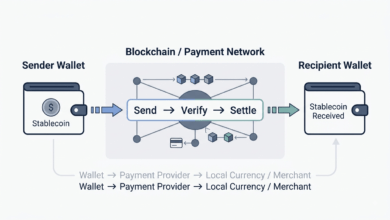
Stablecoins serve as the functional bridge between traditional fiat currency and open-source blockchain networks. As stablecoin architecture matures, its applications extend far beyond trading collateral into global payment infrastructure.
+-----------------------------------------------------------------------+
|                         STABLECOIN SPECTRUM                           |
+-----------------------------------------------------------------------+
| Fiat-Backed           | Algorithmic/Delta-Neutral | Yield-Bearing     |
| (e.g., USDC, USDT)    | (e.g., USDe)              | (e.g., sDAI)      |
| High stability,       | Complex stabilization,    | Passes treasury   |
| centralized reserves  | market risk exposed       | yields directly   |
+-----------------------------------------------------------------------+
Yield-bearing stablecoins pass baseline interest earned from underlying treasury reserves directly to holders, challenging traditional low-yield savings accounts. Meanwhile, cross-border remittances—historically burdened by high transfer fees and settlement delays—can settle globally in seconds for fractions of a cent. Integrating stablecoins into point-of-sale systems, payroll platforms, and corporate treasury management establishes a persistent, real-world utility layer for Web3 finance.
DeFi and the Tokenization of Traditional Finance
The boundary separating legacy financial institutions from open blockchain protocols is gradually dissolving. Institutional adoption is transitioning from cautious experimentation to operational deployment.
Investment banks, asset managers, and financial market infrastructures are deploying private and permissioned subnetworks that interoperate with public blockchains. Tokenized money-market funds allow treasury managers to move collateral instantly between protocols around the clock. By digitizing corporate credit, private equity shares, and syndicated loans, financial institutions can eliminate manual reconciliation steps, lower back-office administrative overhead, and improve trade settlement efficiency.
The Role of AI and Automation in Next-Generation DeFi
Combining Artificial Intelligence with programmatic finance introduces autonomous execution to open financial markets. AI agents equipped with cryptographic wallets can independently analyze market data, execute trading strategies, and balance portfolios based on defined risk thresholds.
-
Smart Portfolio Rebalancing: Algorithmic agents continuously adjust collateral ratios across protocols to maximize yield while avoiding liquidation.
-
Automated Yield Optimization: AI tools evaluate protocol smart contract risk against real-time returns to route funds dynamically.
-
Programmatic Micro-Payments: AI agents independently pay for compute resources, storage, and API data feeds on a pay-per-use basis without human intervention.
While automated execution optimizes strategy performance, it also introduces systemic risk. Algorithmic strategies executing on identical underlying data can trigger feedback loops, compounding market volatility during unexpected liquidity shifts.
Cross-Chain DeFi and Interoperability
Liquidity in the early days of Web3 was isolated within standalone blockchain environments. Today, cross-chain communication standards enable seamless asset transfer and execution across multiple network layers.
Chain-agnostic applications allow users to deposit collateral on one blockchain network and borrow assets or execute trades on another without interacting with risky manual bridging interfaces. Standardized interoperability protocols use secure messaging frameworks to relay verifiable data between disparate networks. Unifying liquidity across diverse Layer-1 and Layer-2 environments eliminates market fragmentation, deepens order books, and improves execution quality for users regardless of their underlying network hosting.
The Biggest Challenges Facing DeFi’s Next Phase
Despite significant technological strides, achieving widespread, mainstream adoption requires resolving critical operational, structural, and regulatory obstacles:
+-----------------------------------------------------------------------+
|                    CRITICAL ADOPTION OBSTACLES                        |
+-----------------------------------------------------------------------+
| [Regulatory Ambiguity]  ---> Global fragmentation & compliance burdens |
| [Security Vulnerabilities] ---> Smart contract bugs & oracle exploits |
| [User Experience (UX)] ---> Complex seed phrases & gas management     |
| [Liquidity Division]   ---> Fragmented capital across L1s and L2s     |
+-----------------------------------------------------------------------+
-
Regulatory Uncertainty: Global compliance frameworks surrounding anti-money laundering (AML), know-your-customer (KYC) standards, and token classifications remain fragmented across jurisdictions.
-
Security and Protocol Exploits: Smart contract vulnerabilities, economic design flaws, and oracle manipulation attacks continue to result in capital losses.
-
User Experience Complexity: Managing cryptographic keys, gas token dynamics, and cross-chain transactions poses significant UX barriers for non-technical users.
-
Liquidity Fragmentation: The proliferation of competing Layer-1 and Layer-2 networks risks scattering capital across isolated ecosystems.
-
Governance Vulnerabilities: Token-weighted voting structures in decentralized autonomous organizations (DAOs) remain susceptible to low participation, voter apathy, and governance capture by major token holders.
What the Future of DeFi Could Look Like
Over the next decade, decentralized infrastructure is poised to shift from an isolated sector into the underlying processing layer for global commerce. Rather than explicitly interacting with “DeFi,” users will likely use everyday applications powered by open-source smart contracts behind the scenes.
In this integrated paradigm, a business owner might take out a commercial credit line backed by tokenized real estate, automatically hedge foreign currency exposure using algorithmic options, and settle international supplier invoices instantly via yield-bearing stablecoins—all orchestrated by AI financial agents. By abstracting away technical complexity, open blockchain networks can offer unprecedented transparency, lower transaction friction, and broader access to capital markets.
The future of decentralized finance is expanding far beyond its initial experiments with lending pools and staking yields. By integrating tokenized real-world assets, algorithmic insurance, institutional-grade derivatives, and AI-driven automation into an interoperable multi-chain structure, open finance is evolving into a comprehensive global financial framework. Achieving long-term, mainstream adoption requires solving key challenges around security, user interface design, regulatory clarity, and capital efficiency. As these foundational layers stabilize, decentralized networks will continue redefining how value is created, traded, and managed worldwide.